A tax audit is a comprehensive assessment of a company’s overall business model.
The tax authorities do not assess individual taxes in isolation, but rather analyse the economic substance and structure of transactions, the quality of their documentation, the consistency between primary documents, accounting records, tax and financial reporting, as well as the overall integrity and internal consistency of the tax framework.
Within a tax audit, tax implications are not evaluated separately, but in conjunction with the actual business activities of the company, the substance of transactions, their business purpose, accounting treatment and the robustness of the supporting evidence.
Accordingly, corporate income tax, VAT and other taxes represent only individual elements within a broader, integrated assessment of the taxpayer’s operations.
For this reason, effective tax audit support is primarily about building a coherent factual and legal position for the company, rather than merely responding to information requests or addressing isolated procedural aspects of the audit.
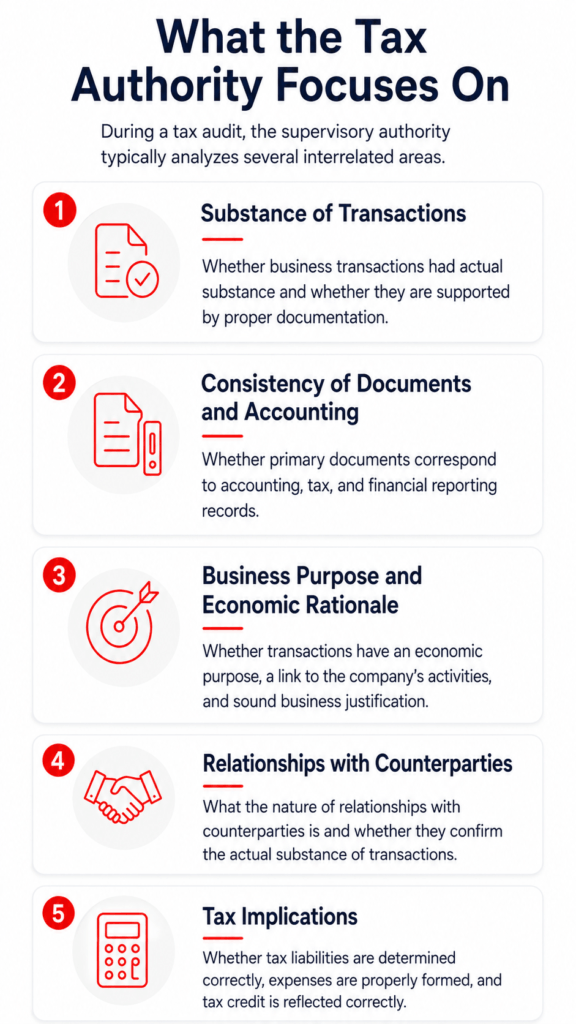
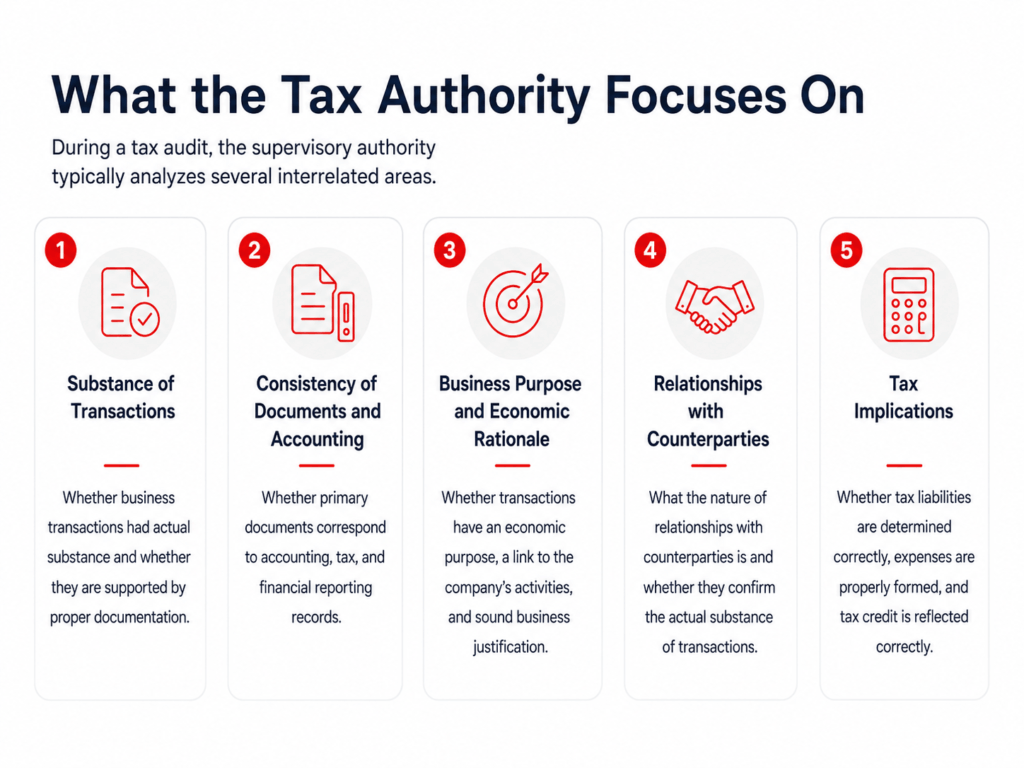
During a tax audit, the tax authorities typically focus on the following areas:
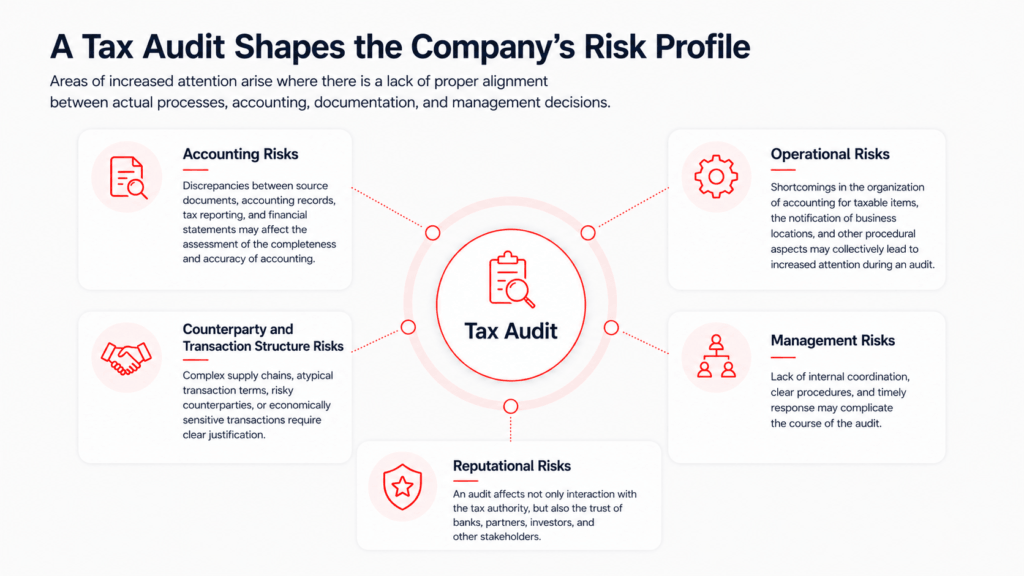
For businesses operating within structured and established models, a tax audit is associated not only with the risk of additional tax assessments. Areas of increased scrutiny typically arise where there is a lack of alignment between actual business processes, accounting records, documentation and management decisions.
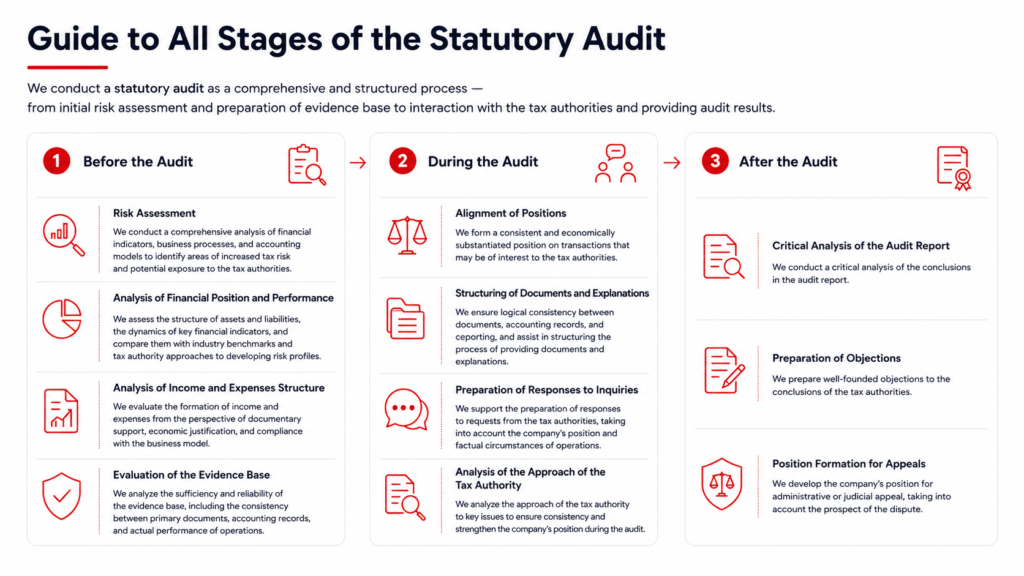
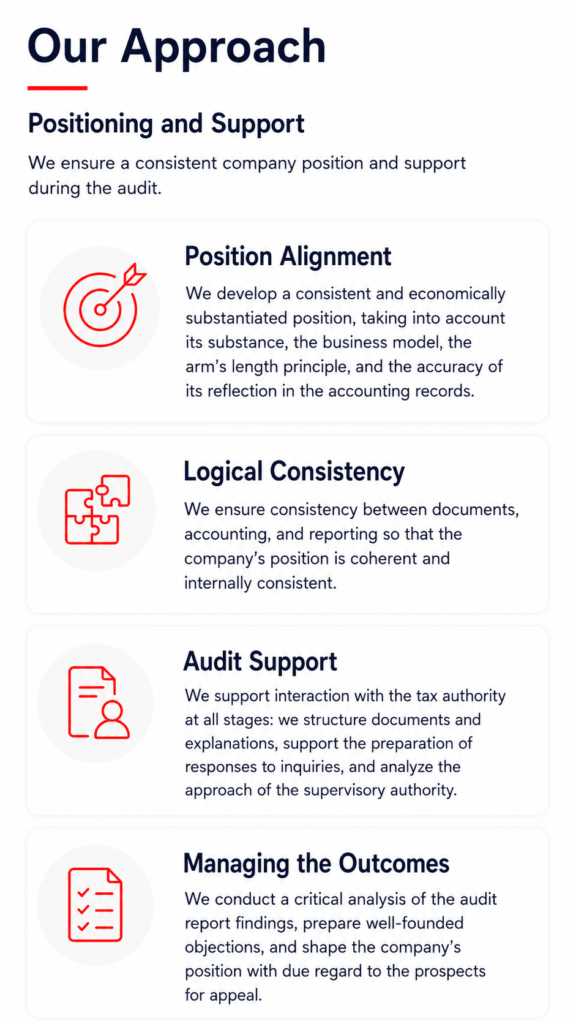
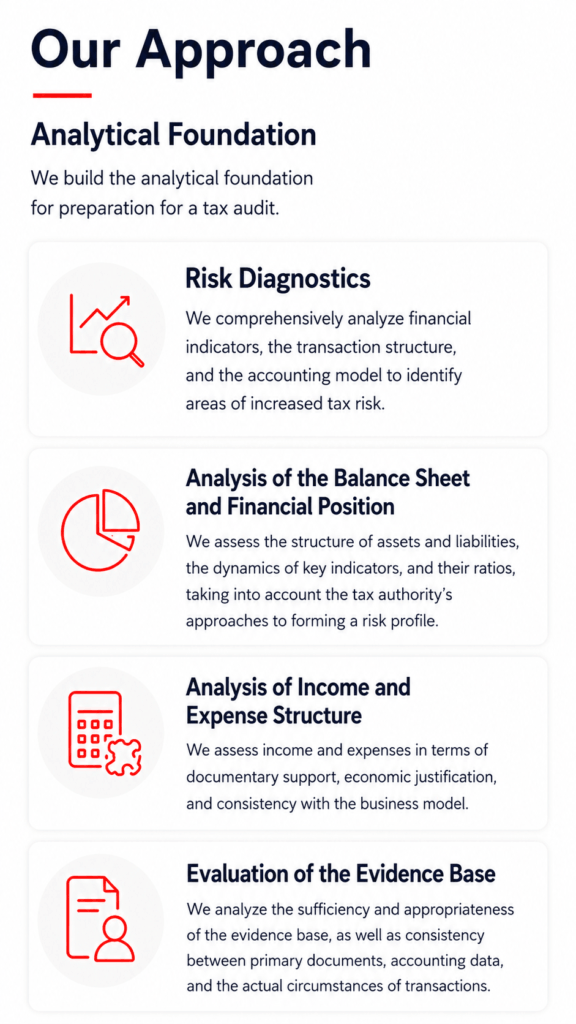
We manage a tax audit as a structured and controlled process – from upfront risk diagnostics and preparation of supporting evidence to handling interactions with the tax authorities and addressing the outcomes of the audit.
Our approach is not reactive. It is based on the early development of a well-grounded, internally consistent position that withstands scrutiny both from a documentation perspective and in terms of the economic substance of transactions.
The most effective approach is to engage support before the audit commences, at the stage of preventive diagnostics. This makes it possible to systematically analyse the accounting model, the evidentiary base and the risk areas, align the company’s position and prepare for potential requests from the controlling authority. Engagement at the stage of an already commenced audit also delivers results; however, the scope of available corrective actions narrows, as part of the explanations and documents has already been provided. The most challenging scenario is the engagement of a consultant after receipt of the audit report – in such cases, a number of positions have to be defended through administrative or judicial proceedings, which could have been avoided at earlier stages.
The engagement of professional support is a well-established practice for medium-sized and large businesses and is not regarded by the controlling authority as an indication of violations. A structured position, properly drafted explanations and timely responses to requests, on the contrary, make the course of the audit more predictable. By contrast, inconsistent communication, contradictory explanations and delays in providing documents create a substantially higher level of risk.
There are no direct universal indicators; however, there is a range of signs that typically precede an audit: an increase in the number and level of detail of requests from the State Tax Service, requests concerning specific counterparties or transactions, summons of officials to provide explanations, cross-reconciliations with counterparties, as well as heightened activity in the monitoring of tax invoices, in particular their blocking or suspension of registration. Separately, attention should be paid to the publication of the schedule of documentary scheduled audits, which the State Tax Service publishes on its official web portal. As part of preventive diagnostics, we assess the company’s risk profile taking into account the criteria applied by the controlling authority when forming the audit plan.
Tax legislation provides for several formats of audits: desk audits (conducted on the basis of tax reporting data and the controlling authority’s information databases without visiting the taxpayer’s premises), documentary scheduled and unscheduled audits, as well as factual audits. The most extensive in terms of the scope of analysis and potential risks are documentary scheduled audits, which cover a wide range of issues over a significant period of activity. Documentary unscheduled audits are appointed where statutorily defined grounds exist and often focus on specific transactions or counterparties. The support strategy is developed taking into account the type of audit, its subject matter and the scope of risks.
The principal areas of analysis include: the reality of business transactions and the quality of their documentary support; the existence of a business purpose and economic justification of transactions; the consistency of primary documents with accounting records, tax and financial reporting; the nature of relationships with counterparties; non-standard contractual terms; transactions with low margin levels or deviations from market conditions; and transfer pricing matters within groups of companies. The specific focus of an audit depends on the industry, the business model and the information available to the controlling authority regarding the taxpayer’s activities.
Engagements are conducted in compliance with the requirements of professional secrecy, internal information security policies and personal data protection legislation. Access to information is limited to the project team, while the confidentiality regime, the procedure for the transfer of documents and restrictions on the use of information are set out in the engagement agreement. Separate provisions govern the handling of information constituting commercial secrets and the procedures for engagement with third parties within the scope of the project.
In addition to assessments of principal tax amounts and financial penalties, the outcomes of an audit may affect a number of related aspects of the company’s operations: the recognition of provisions or contingent liabilities in the financial statements, interaction with auditors during the confirmation of the annual financial statements, compliance with financial covenants under credit facility agreements, and business reputation in relations with banks and investors. In certain cases, audit outcomes may give rise to questions concerning the personal liability of officials. Comprehensive support takes all these dimensions into account and shapes the company’s position with regard to the full spectrum of potential consequences, rather than solely the immediate tax risks.
The appeal of audit results is a logical extension of the engagement and is delivered by the same team that has been managing the project. At the same time, work on the consequences of an audit – the preparation of objections to the audit report, administrative appeal of tax assessment notices, and legal challenges – serve as a separate area of cooperation. The scope of work, the composition of the team and the terms of engagement are determined on a case-by-case basis, taking into account the nature of the dispute, the volume of materials and the chosen defence strategy. The key advantage of an integrated approach lies in the continuity of case management: the factual circumstances established during the audit and the legal position maintained at the appeal stage remain aligned, without the need for a new team to re-examine the case materials from the outset.
We develop a consistent and professionally sound corporate stance that is sound both from an accounting perspective and in terms of the economic logic of the transactions.
Taking into account the economic substance of business transactions, their documentary evidence, the accounting model, tax implications and the approaches adopted by the tax authority.
A controlled and predictable audit process, minimising the risk of critical or unfounded findings, and providing assurance that the company is properly prepared to engage with the regulatory authority at every stage.
To develop a well-documented, compliant, and future-ready international structure tailored to your business strategy.