Tax Dispute Resolution and Representation

Tax Dispute Resolution and Representation

A tax dispute is a distinct stage in the defence of a taxpayer and should not be viewed merely as a continuation of a tax audit or a formal challenge to its results.

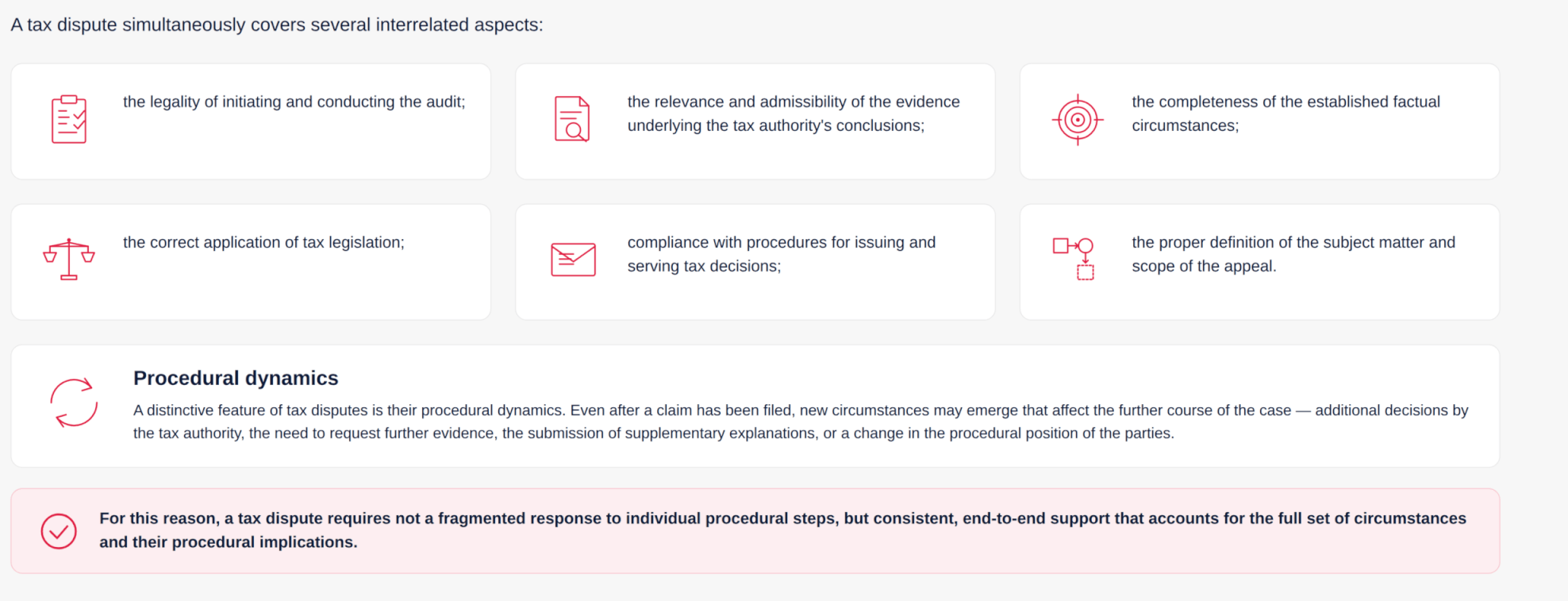
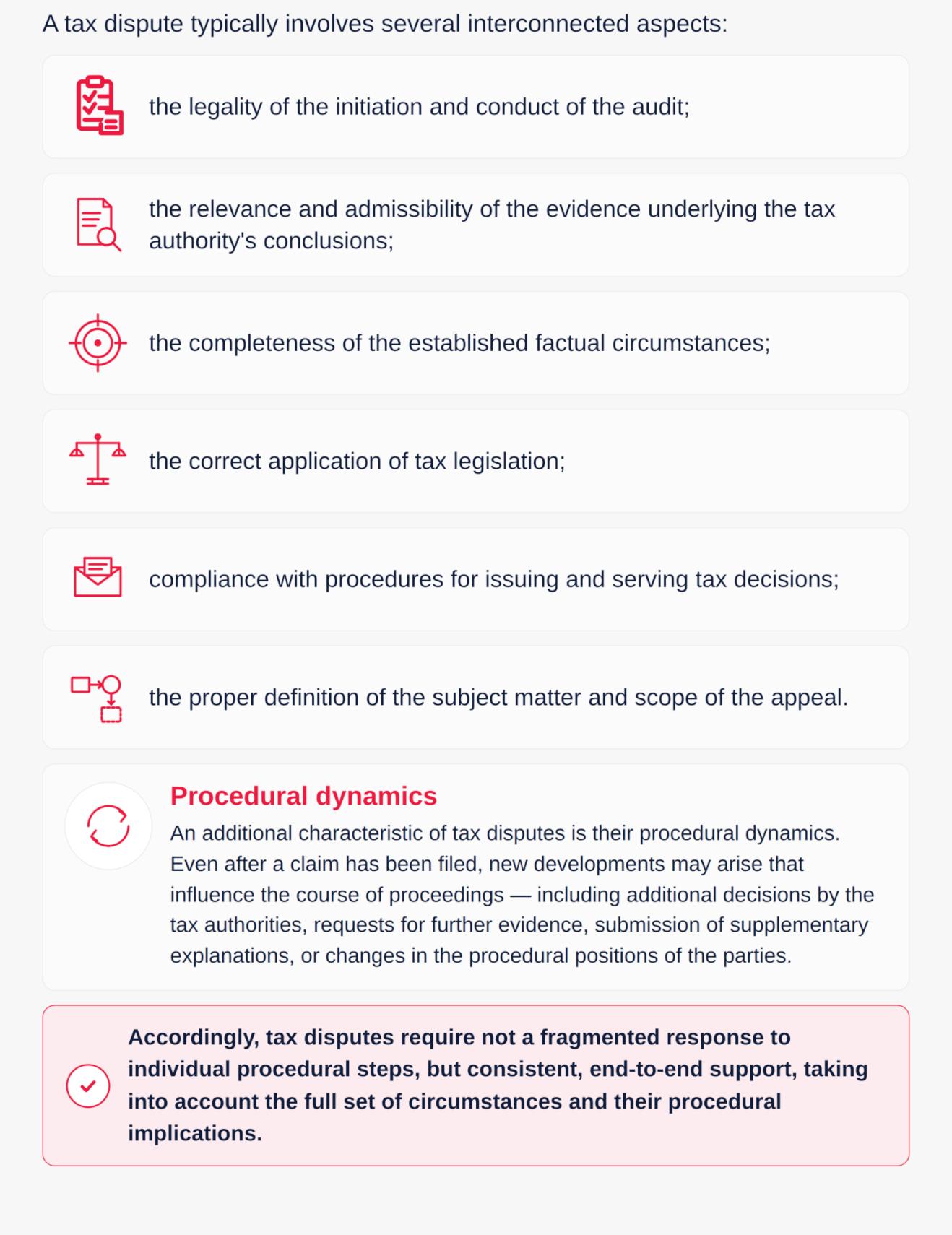
Within this process, the outcome depends not only on substantive legal arguments, but also on the proper definition of the subject matter of the dispute, the accurate formulation of claims, the completeness and admissibility of evidence, as well as strict compliance with procedural timelines and requirements.


In practice, the result of a tax dispute often depends on whether the legal position was developed in a structured manner at the stage of reviewing the audit findings, whether the factual background, explanations and supporting documentation are consistent, and whether procedural opportunities have been preserved without being undermined by errors in the appeal process or delays in procedural actions.


For this reason, tax dispute support is not limited to the preparation of individual procedural documents. It is a consistent legal process focused on the entire dispute framework — from analysing the audit report and materials of the tax authorities to developing and implementing the company’s position in both administrative and judicial proceedings.

податкові спори

Who This Is Relevant For

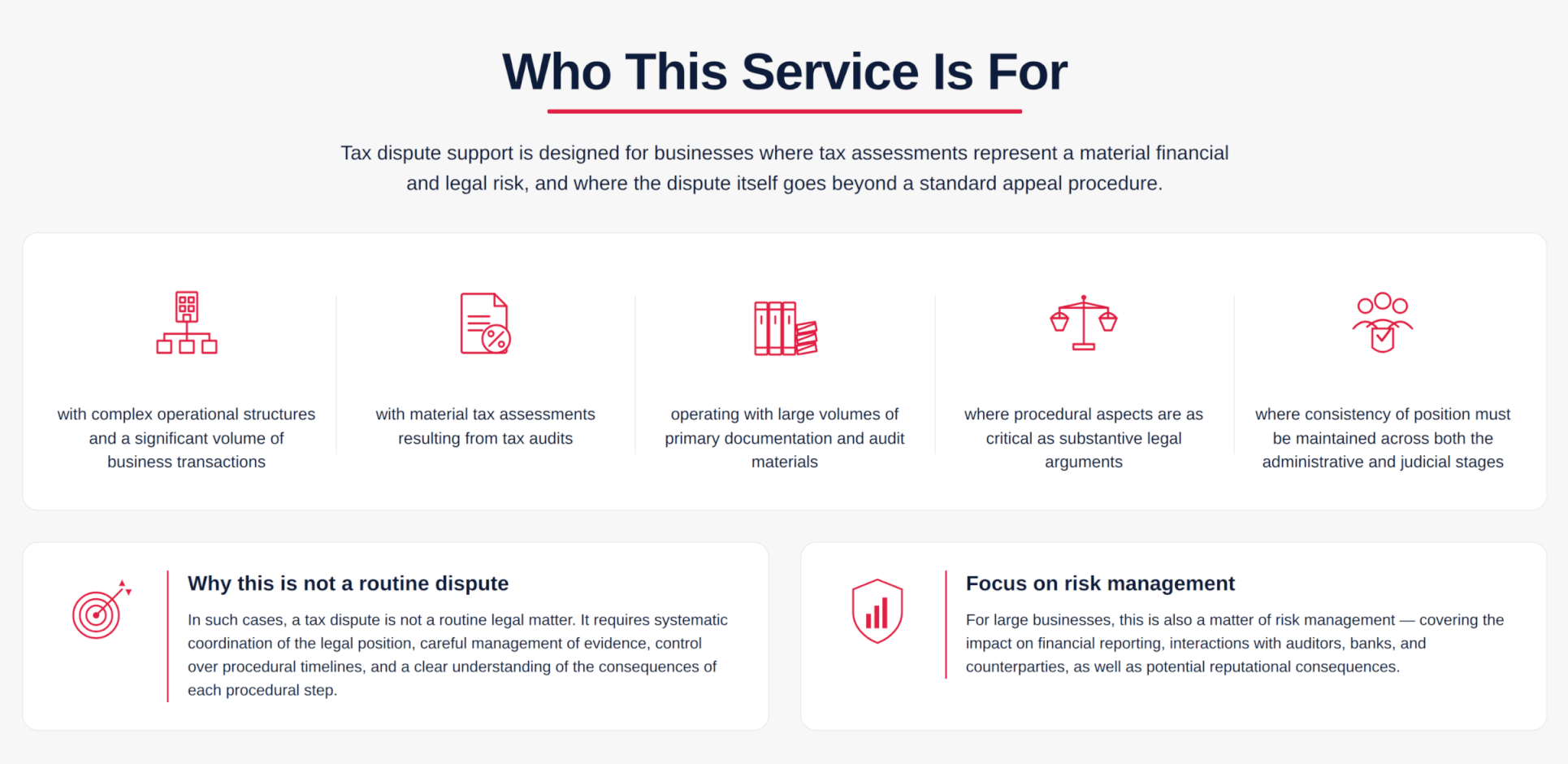
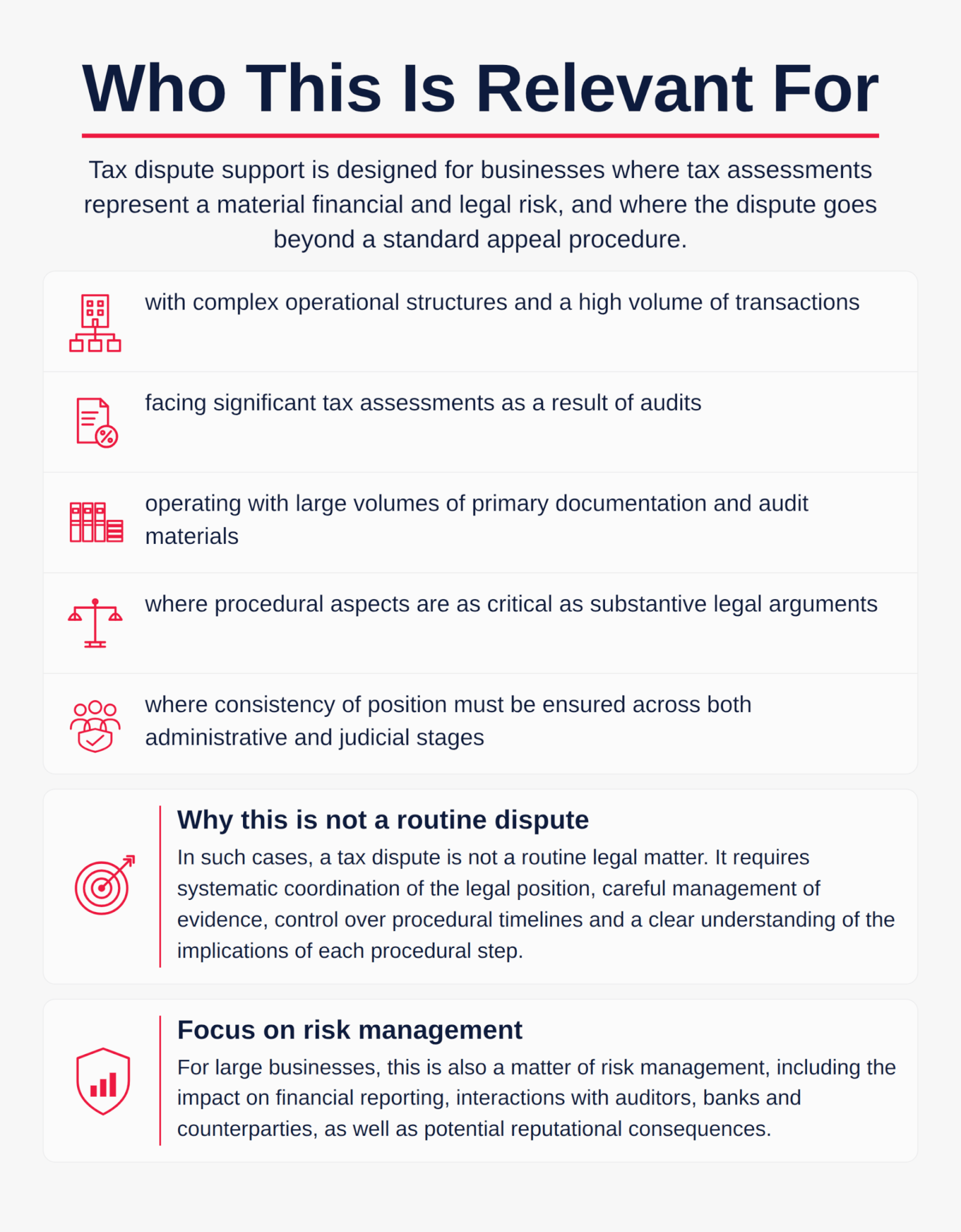
Tax dispute support is designed for businesses where tax assessments represent a material financial and legal risk, and where the dispute goes beyond a standard appeal procedure.

It is particularly relevant for companies:

  • with complex operational structures and a high volume of transactions;
  • facing significant tax assessments as a result of audits;
  • operating with large volumes of primary documentation and audit materials;
  • where procedural aspects are as critical as substantive legal arguments;
  • where consistency of position must be ensured across both administrative and judicial stages.

In such cases, a tax dispute is not a routine legal matter. It requires systematic coordination of the legal position, careful management of evidence, control over procedural timelines and a clear understanding of the implications of each procedural step.


For large businesses, this is also a matter of risk management, including the impact on financial reporting, interactions with auditors, banks and counterparties, as well as potential reputational consequences.

Tax Disputes in Practice

In practice, the key legal positions in tax disputes are formed well before the case reaches court.
A dispute effectively begins with the issuance of the audit report and develops through the submission of objections, the receipt and challenge of tax assessments, and the documentation of factual circumstances that will later form the basis of evidence.


Each of these stages has independent procedural significance.
Deadlines for submitting objections, the procedures for serving tax assessments, and the scope and substance of administrative appeals directly affect the boundaries of future court proceedings and the admissibility of certain arguments.

Administrative Appeal

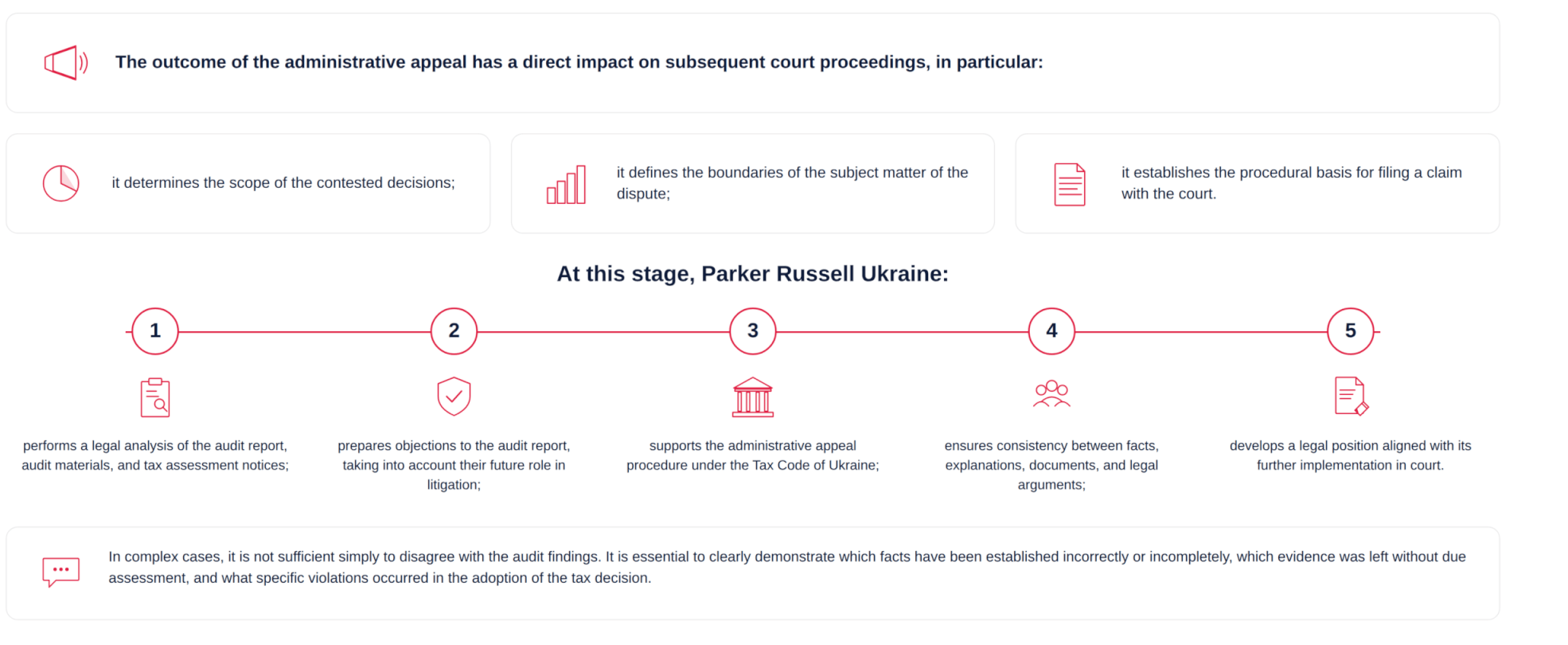
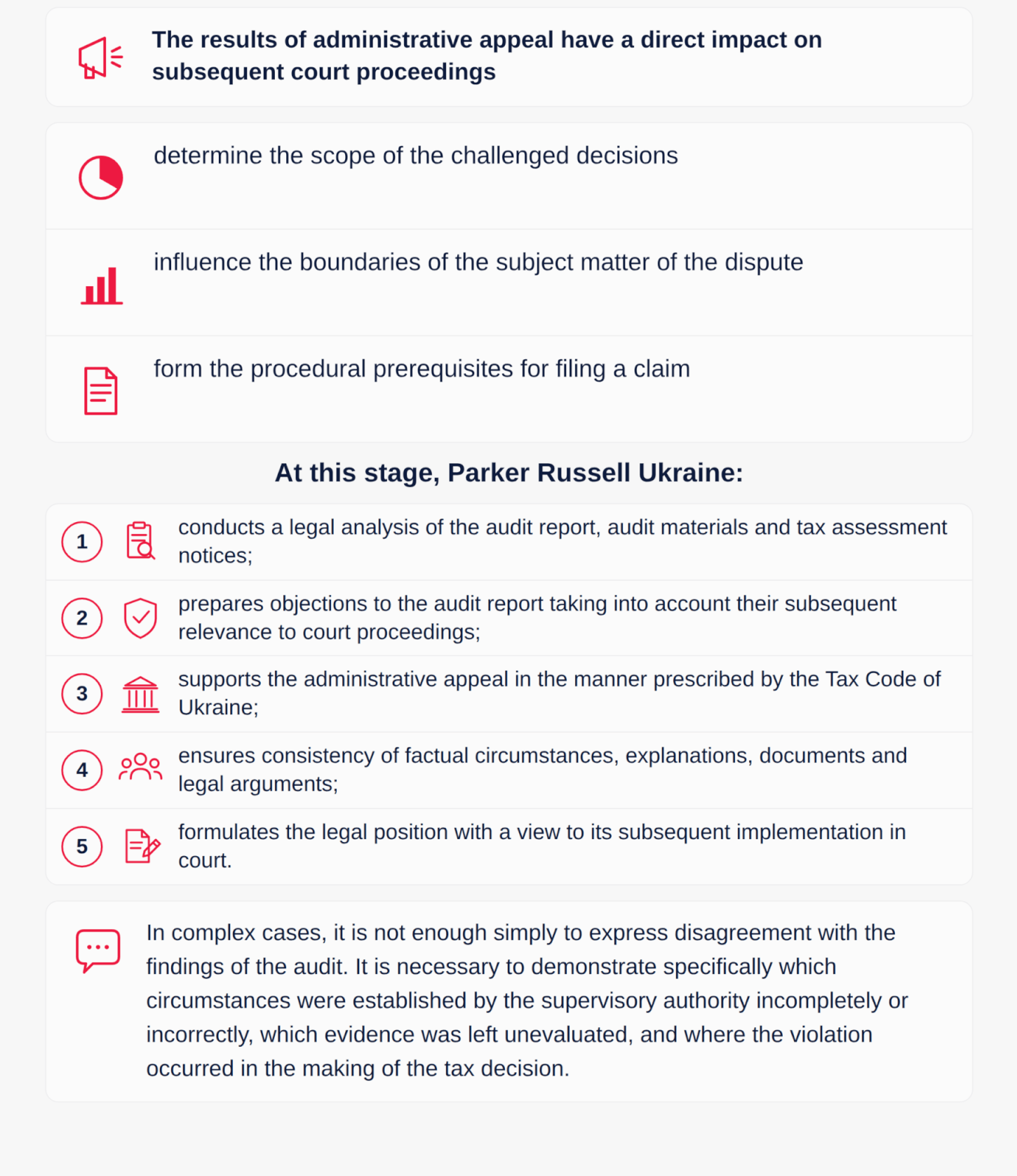
Administrative appeal in tax disputes is not merely a formal stage preceding litigation.
It is at this stage that the scope of the future dispute is defined, the taxpayer’s key arguments are established, and the evidentiary base is formed — all of which will subsequently be assessed by the court.


During the review of objections to the audit report and the administrative appeal, it becomes clear:

  • which factual circumstances and evidence underpin the position of the tax authorities;
  • which documents have not been properly considered;
  • where inconsistencies or gaps exist within the audit materials.

Litigation (Judicial Proceedings)

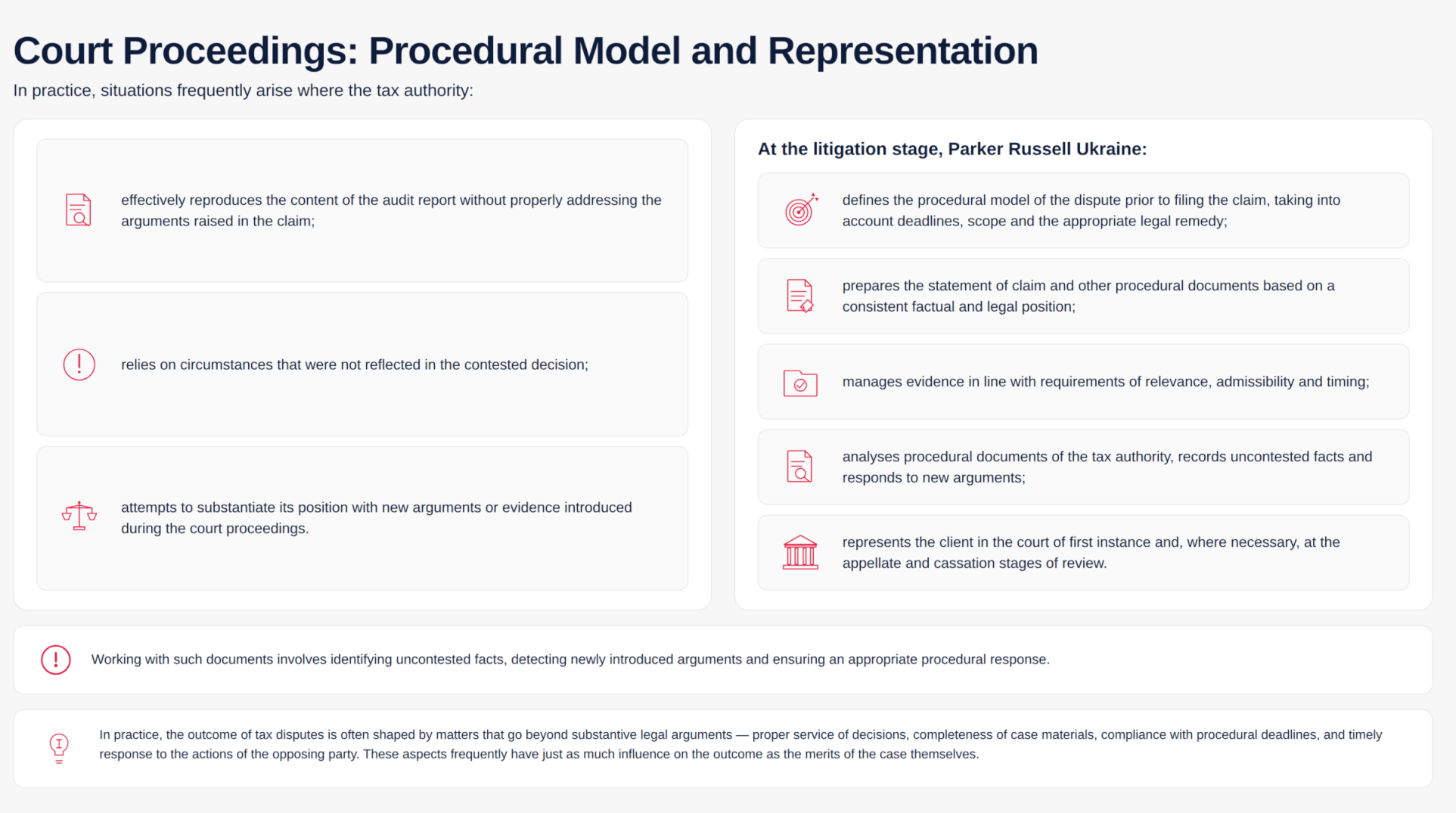
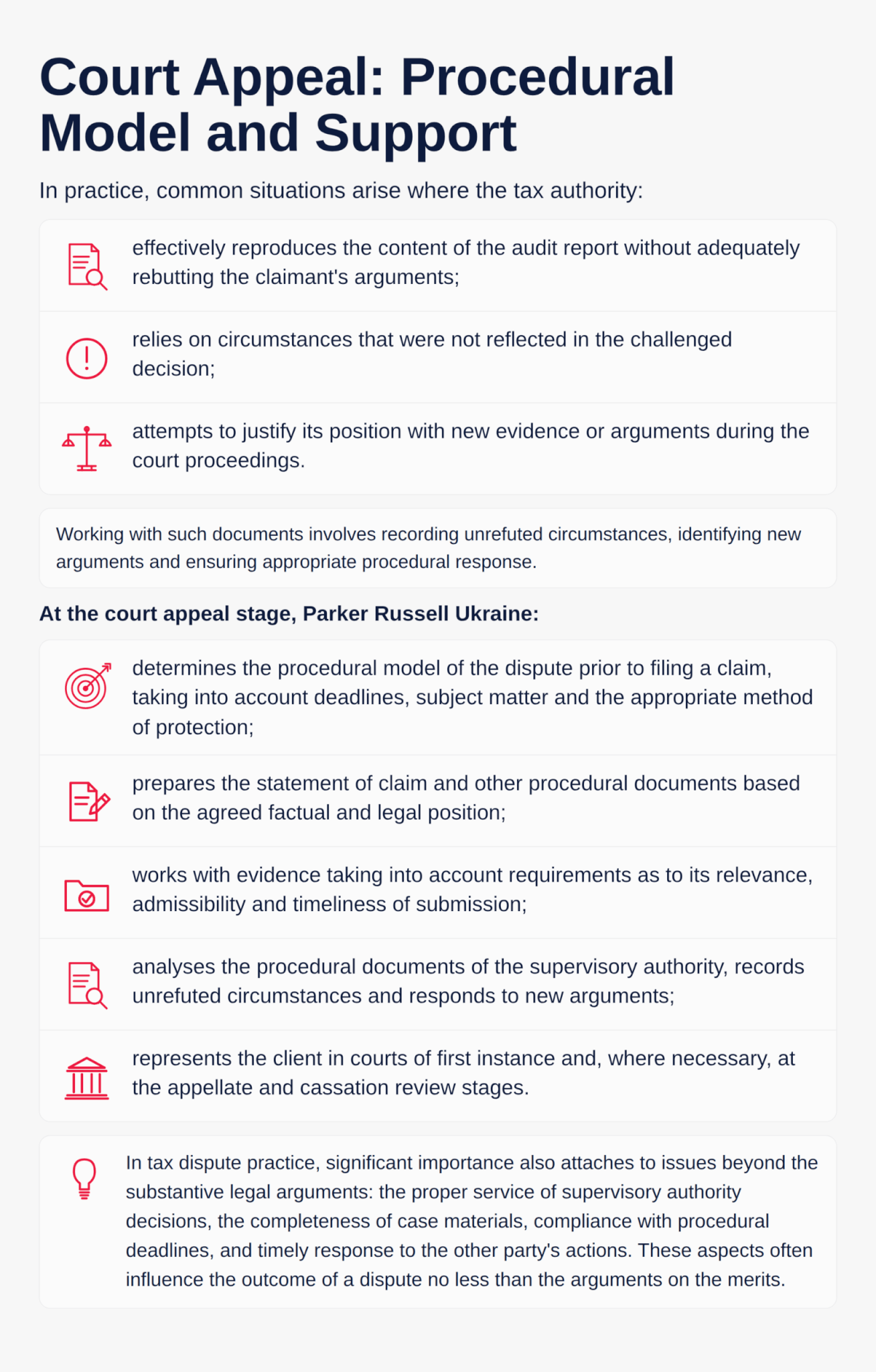
Litigation in tax disputes requires a clearly structured legal position covering the subject matter of the claim, the appropriate remedy, the body of evidence and the procedural strategy.
At this stage, the dispute is assessed strictly within the limits of the claims, arguments and evidence properly submitted to the court.


Key factors include:

  • the accurate formulation of claims and definition of the scope of judicial review;
  • compliance with statutory deadlines for filing a claim, taking into account the outcomes of administrative appeal;
  • the relevance, admissibility and sufficiency of evidence;
  • consistency between the factual background and legal arguments;
  • timely submission of explanations and procedural documents.

In tax disputes, the court does not assess circumstances in general terms.
It evaluates specific arguments and the evidence supporting or refuting them. Accordingly, the decisive factor is not the volume of materials submitted, but their connection to the subject matter of proof and their ability to challenge the conclusions underlying the tax assessment.

Particular attention is given to the procedural documents of the tax authorities.

Evidence Management and Procedural Discipline

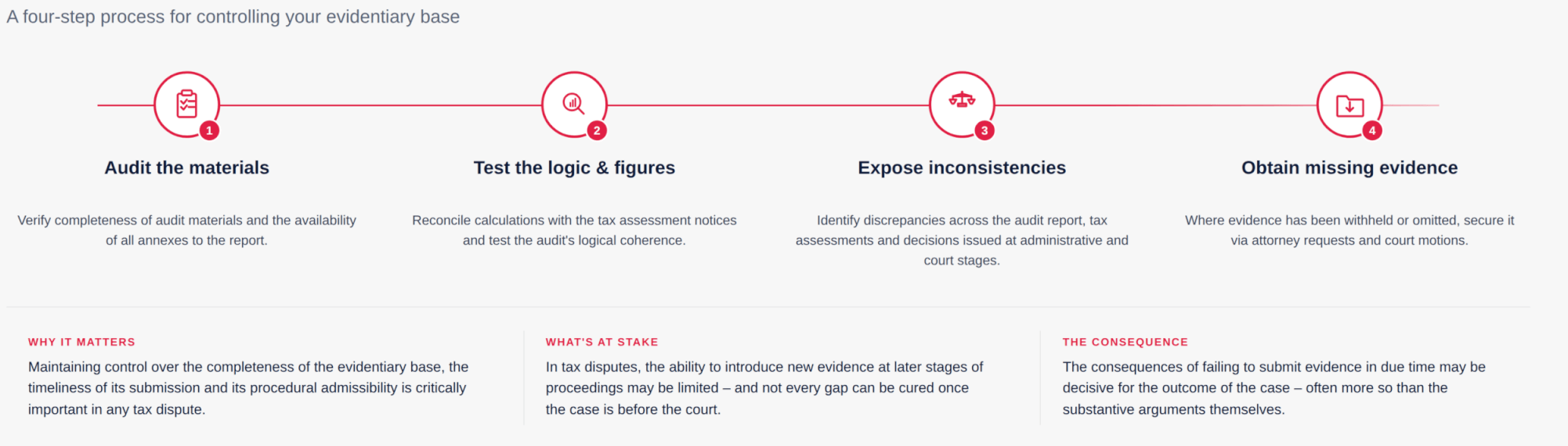
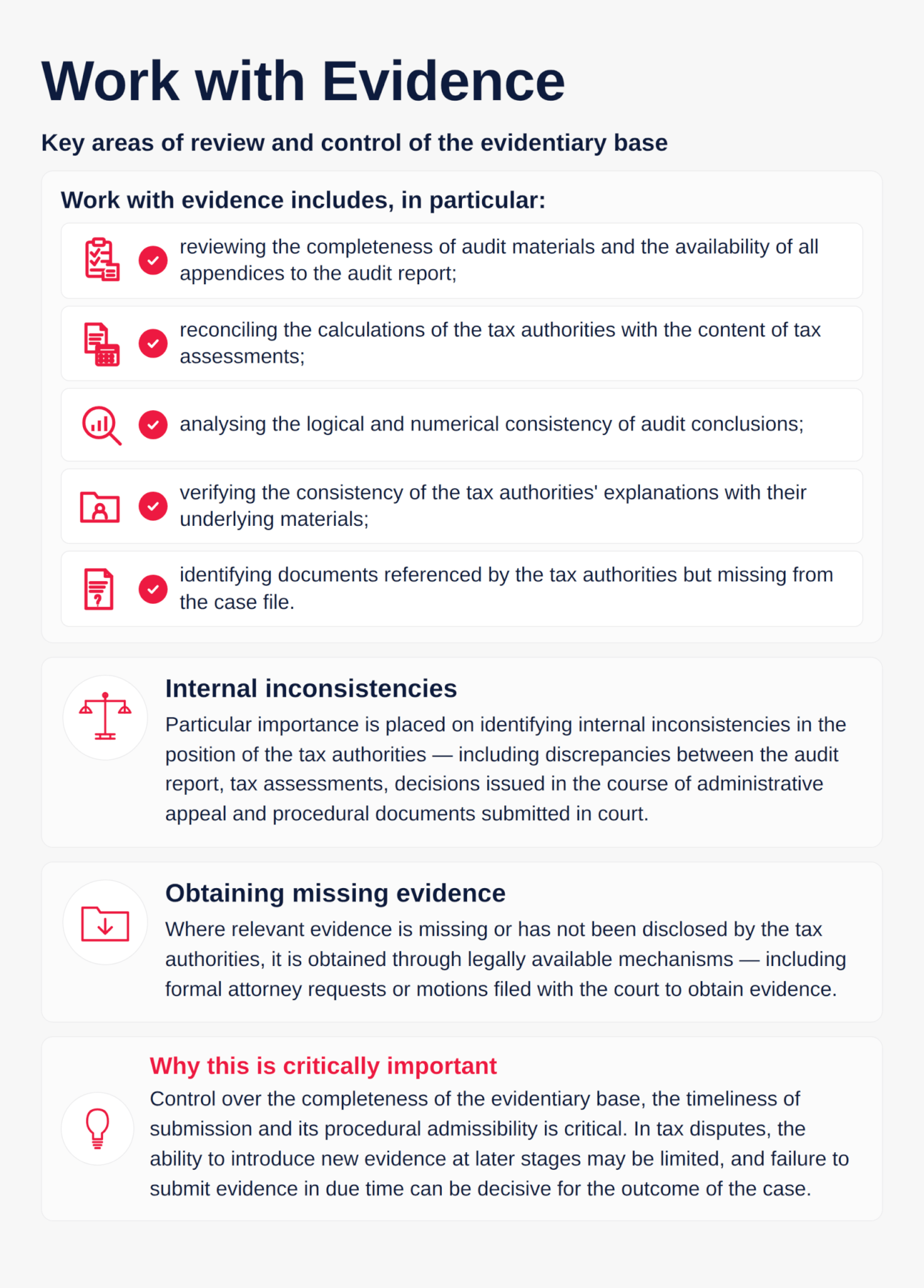
In tax disputes, the decisive factor is not the formal existence of documents, but which evidence is included in the case file, what facts it supports, and whether it can be relied upon by the court in accordance with procedural requirements.


The evidentiary base in such cases is built progressively — from audit materials and objections to the audit report, through the administrative appeal, and ultimately to the evidence submitted in court.
Each piece of evidence is assessed in terms of its relevance, admissibility, reliability and sufficiency.

FAQ

At what stage of a tax dispute is it advisable to engage an external advisor?

Engagement at the stage of reviewing the tax audit report provides the broadest range of procedural opportunities: objections to the audit report and the administrative appeal shape the factual basis and the arguments on which any subsequent judicial review will rely.

Engagement after the tax assessment notice has been issued, or at the judicial stage – first instance, appeal, or cassation – is also possible; in such cases, the first step is a legal review of the position already formed, including which arguments have been recorded in the case file, which procedural opportunities remain available at the relevant instance, and which have been foreclosed by the prior course of the dispute.

Two formats of cooperation are supported: full-scope representation and support of the client’s existing team – methodological analysis, preparation of selected procedural documents, expert assessment of the position, work on the evidentiary basis, or representation at specific instances.

The allocation of functions, the scope of authority, and the channels of communication are set at the outset, which ensures a consistent line of argument across all stages and eliminates duplication of procedural actions.

The engagement is comprehensive and covers: legal analysis of the tax audit report, the case file of the tax authority, and the tax assessment notices; preparation of objections, the administrative appeal, the statement of claim, and other procedural documents; work on the evidentiary basis, including the initiation of procedural requests and motions for the production of evidence in the manner provided by law, subject to the composition of the legal team engaged on the specific matter; representation of the client’s interests before the tax authority and in the administrative courts; and response to the respondent’s procedural filings throughout the proceedings.

Under the administrative appeal procedure, a complaint must be submitted to the higher-level supervisory authority in writing or electronically via electronic means of communication within 10 working days following the date on which the taxpayer received the decision of the supervisory authority being appealed. Such a complaint is considered by the supervisory authority within 20 calendar days of receipt and may be extended to 60 calendar days.

A decision of the State Tax Service may be challenged in court within one month of the conclusion of the administrative appeal procedure.

The accounting implications also require attention: under IAS 37, the existence of a tax dispute requires assessment and appropriate disclosure in the financial statements – as a provision or as a contingent liability, depending on the probability of an outflow of resources and whether a reliable estimate can be made. Because the auditors and lawyers within Parker Russell Ukraine operate as a single team, consistency is ensured between the legal position and the manner of its reflection in the financial statements, including readiness for enquiries from the auditor, banks, and counterparties.

Engagement at later stages is procedurally permissible. The work begins with a legal review of the case: the arguments recorded in the statement of claim, the appeal, and the court rulings are assessed, together with the facts that have become uncontested and the procedural opportunities that remain available within the powers of the relevant instance. On this basis, a realistic strategy is developed, with transparent communication regarding both the limitations created by the prior course of the case and the potential that remains.

It is also taken into account that the cassation instance does not re-assess the factual circumstances but verifies the correct application of substantive law – which directly defines the permissible scope of argumentation.

The work is conducted under the regimes of professional secrecy provided for by law – attorney-client privilege with respect to the involvement of attorneys, and the auditor’s professional secrecy with respect to the financial component. The transfer of documents is formalised contractually, with a defined list of individuals on the provider’s side who have access to the case materials.

Where required, a separate non-disclosure agreement is concluded, taking into account the specific nature of the client’s data, its source, and the regime governing its handling.

The approach is based on three elements.

The first is a cross-disciplinary team: auditors, lawyers, and analysts work on the matter jointly, which is decisive in disputes where the factual circumstances carry both a legal and an accounting dimension – primary documents, accounting records, accounting methodology, and the reflection of the outcome of the dispute in the financial statements.

The second is a systemic rather than fragmented approach: the legal position is built with all subsequent stages in mind already at the stage of the tax audit report.

The third is membership in the Parker Russell International network, which allows the international context to be taken into account in cases with a cross-border element – in particular, transfer pricing, permanent establishments, and transactions with related parties. Together, these elements deliver a coherent position that withstands scrutiny by both the courts and the independent auditor.

Our experts

Other services

Why Parker Russell UA?

Global Presence

in 75 Countries

We work closely with our international partners to implement local solutions that comply with national and global regulations.

Multidisciplinary Expertise

Our team integrates legal, tax, financial, and audit professionals.

Screenshot 2025-06-16 at 13.55.45

Proven Experience

We support Ukrainian enterprises in various industries in building transparent and legally sound international structures.

Commitment to Compliance

All structures we advise on are aligned with OECD BEPS Action Plans, FATF principles, and Ukrainian tax and reporting regulations.

Contact us today

To develop a well-documented, compliant, and future-ready international structure tailored to your business strategy.

Contact us today

To develop a well-documented, compliant, and future-ready international structure tailored to your business strategy.

Fill in all required fields. The application has been sent.

Cookies are used on our site to help give you the best user experience possible and to provide a level of enhanced functionality. If you continue viewing the site without changing your settings, we will assume you are happy to receive all cookies. Your cookie settings can be changed at any time by using the guidelines in our cookie policy. You can also click on the information button for further details.