Controlled Foreign Companies (CFCs)

Transparent Structure. Protected Business. Confident Decisions

CFC reporting rules constitute a comprehensive system of obligations, where deadlines are calculated in days, a full package of documents must be submitted, and penalties may amount to hundreds of thousands of hryvnias.


A
CFC is a foreign company, or an arrangement without legal personality, in respect of which a Ukrainian resident is recognised as a controlling person.


Grounds for recognition as a controlling person include:

  • holding an ownership interest of more than 50%, directly or indirectly;
  • holding an ownership interest of more than 10%, provided that Ukrainian residents collectively hold 50% or more;
  • exercising actual control, meaning control over decisions, assets, or finances even without a “controlling” percentage.

    Note:
    for reporting for previous years, a transitional approach applies for 2022–2023, under which the minimum ownership threshold is 25%.

Parker Russell Ukraine supports you throughout the full CFC cycle:
from determining whether you qualify as a controlling person to preparing the complete set of documents, calculating tax implications, and assisting with submission through the Electronic Taxpayer Cabinet of the State Tax Service of Ukraine.


How Is an Ownership Interest Calculated Through an Ownership Chain?

For CFC purposes, it is important to consider not only direct ownership, but also indirect ownership through a chain of companies or arrangements. The State Tax Service separately emphasises that, where ownership is exercised through a single chain of persons, the indirect ownership interest is determined by multiplying the interests at each level of the chain. Where ownership is exercised through several chains, the interests are aggregated across each chain.


Example: one ownership chain

An individual resident of Ukraine owns 60% of Company A, while Company A owns 40% of the CFC. The resident’s indirect ownership interest in the CFC is calculated as follows:

60% × 40% = 24%

This is the ownership interest used to assess whether control exists.


Example: several ownership chains

A resident owns 60% of Company A, while Company A owns 40% of the CFC, resulting in a 24% indirect interest. At the same time, the resident owns 30% of Company B, while Company B owns 20% of the CFC, resulting in a 6% indirect interest. The resident’s total indirect ownership interest in the CFC is therefore:

24% + 6% = 30%


Note:
when determining an ownership interest, the “100% rule” applies: if a person actually owns more than 50%, through one or several chains, in a legal entity within the chain, that person is deemed to own 100% of such legal entity.


Key Document Blocks for CFC Reporting

To comply with CFC reporting requirements, the controlling person must complete the following three blocks of documents:

  1. CFC Notification
    regarding the acquisition or disposal of an ownership interest, or the commencement or termination of actual control.
  2. CFC Report
    either short-form or full, with appendices.

Annual tax return reflecting CFC income
for individuals, this is the annual tax return on property status and income with the CFC appendix; for legal entities, this is the corporate income tax return with the CFC appendix.

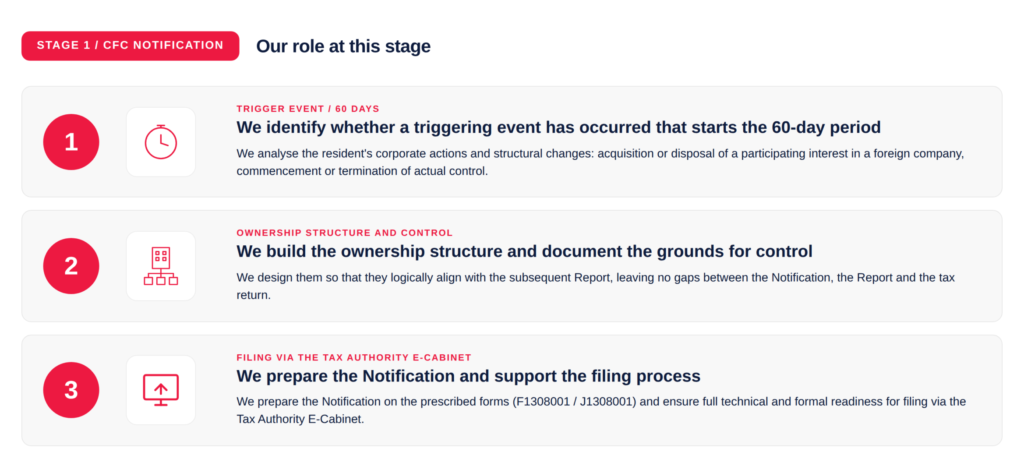
CFC Reporting Roadmap

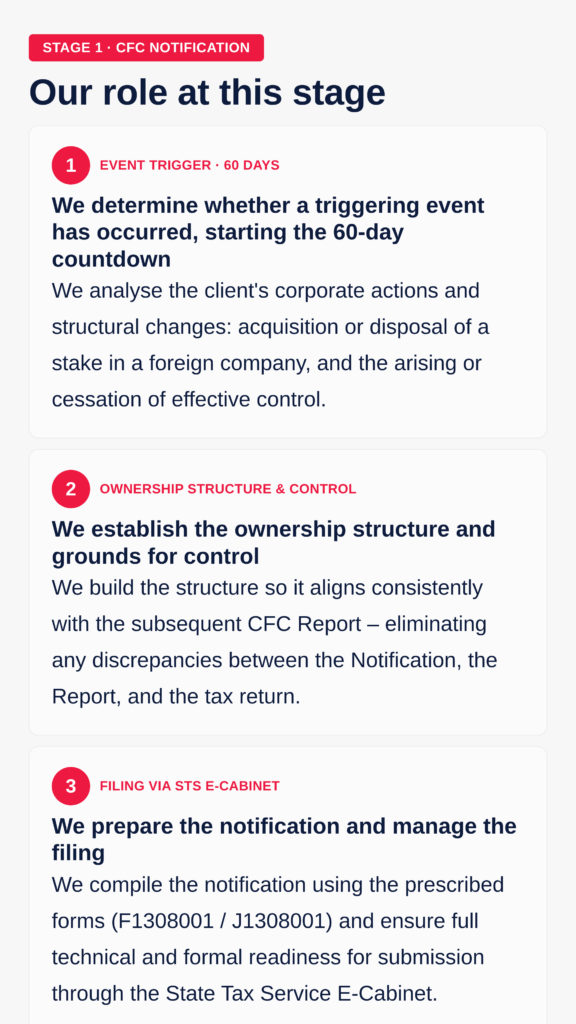
Stage 1. CFC Notification

When it is submitted:
upon acquisition or disposal of an ownership interest in a foreign company, as well as upon the commencement or termination of actual control.

Deadline:
within 60 calendar days from the date of the relevant event.

Form in the Electronic Taxpayer Cabinet:
F1308001 for individuals / J1308001 for legal entities.


What matters in practice:
the critical elements of the notification are the date of the event, the ownership structure, whether direct or indirect, and the logical consistency of the information with the future CFC Report.


Risks in case of non-submission:
a penalty of 300 subsistence minimums for each instance of non-submission.

Note: as of 1 January 2026, the subsistence minimum for able-bodied persons is UAH 3,328.
The total penalty amount is UAH 998,400.

When and how it is submitted:

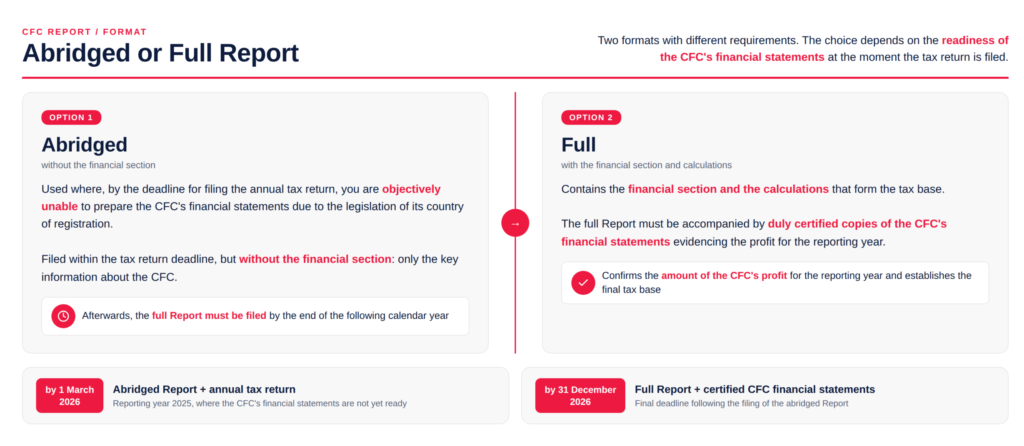
The CFC Report is submitted electronically together with the annual tax return of the controlling person for the relevant calendar year.

In practice, this means that:

  • individuals submit the Report together with the annual tax return on property status and income, by 1 May of the year following the reporting year;
  • legal entities submit the Report together with the annual corporate income tax return, within 60 days after the end of the reporting year, that is, by 1 March.

Financial Risks

Penalties for missing deadlines and incomplete CFC Reports are substantial and often significantly exceed typical penalties for tax reporting violations. To illustrate the scale, based on the subsistence minimum as of 1 January 2026 of UAH 3,328:

  • failure to submit the Report: 100 subsistence minimums = UAH 332,800;
  • late submission of the Report: 1 subsistence minimum for each day of delay, capped at 50 subsistence minimums = up to UAH 166,400;
  • failure to disclose material information in the Report: sanctions may reach 1,000 subsistence minimums = UAH 3,328,000.
cfc report Parker Russell

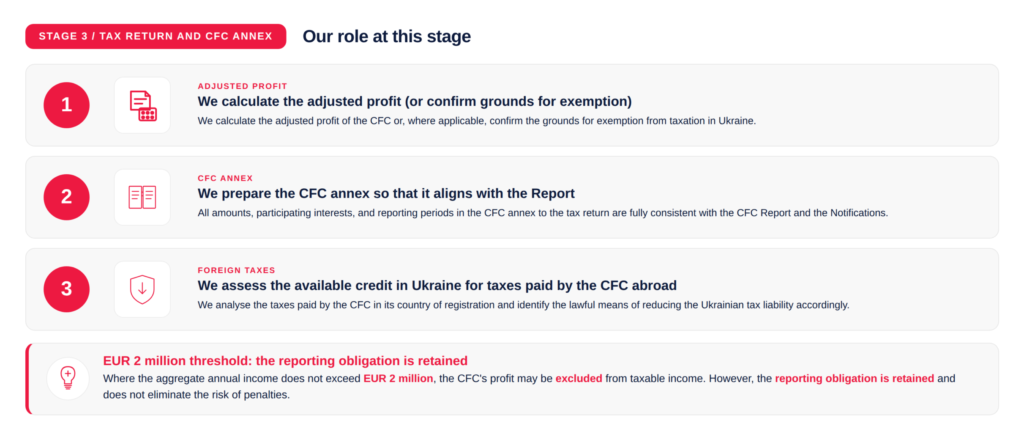
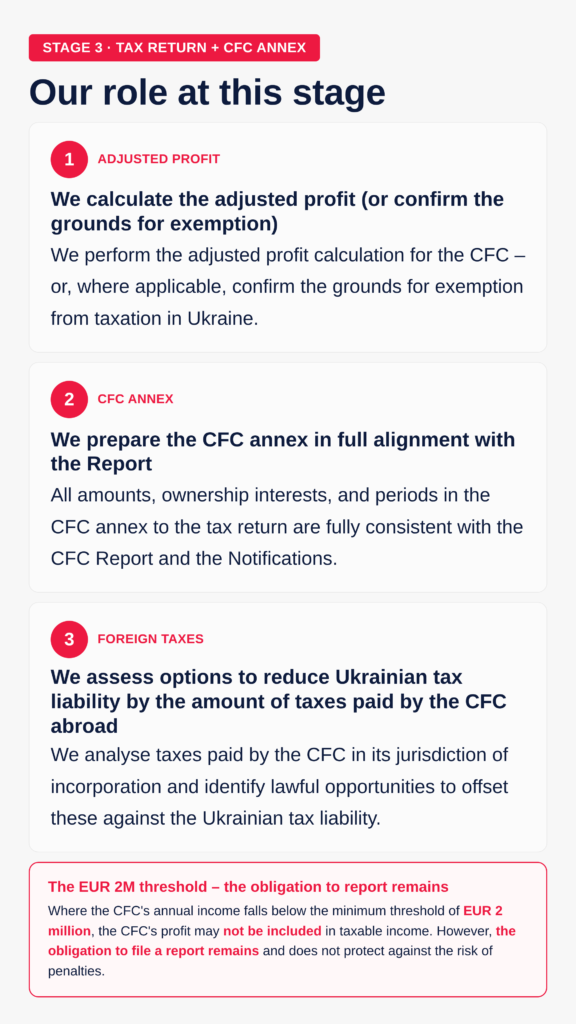
CFC reporting must always be logically completed by submitting a tax return:

  • for individuals, this means the annual tax return on property status and income plus the CFC appendix, including the calculation of personal income tax and military levy on the relevant portion of the CFC’s profit;
  • for legal entities, this means the corporate income tax return plus the CFC appendix, reflecting the impact of the CFC’s adjusted profit on the taxable object.

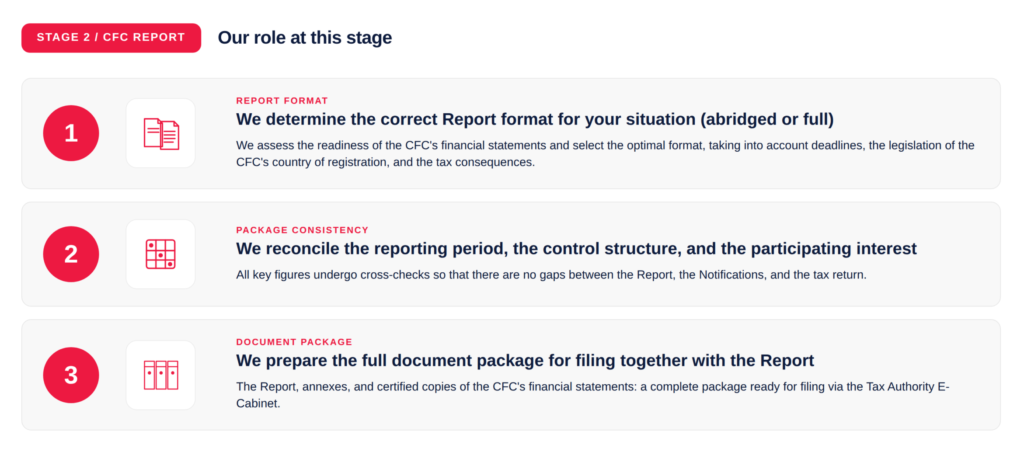
The key requirement is straightforward: the amounts, ownership interests, and periods must be consistent with:

  • the Notification, including the event, ownership interest, and control;
  • the CFC Report, including the data and calculations.

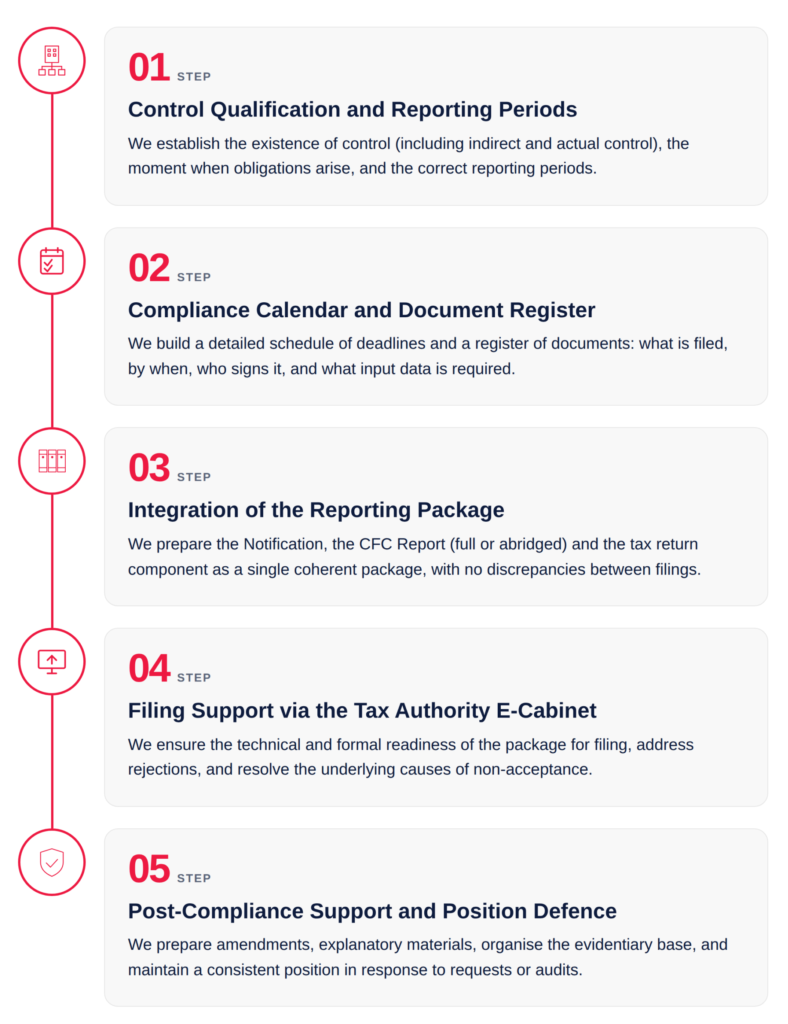
Our Approach

01 Qualification of Control and Determination of Reporting Periods

We establish whether control exists, whether indirect or actual, determine the moment when the relevant obligations arise, and identify the correct reporting periods for CFC reporting.

02   Compliance Calendar and Document Register

We prepare a detailed calendar of deadlines and a list of documents: what exactly must be submitted, within which deadlines, who must sign it, and what source data and supporting evidence are required for submission.

03 Procedural Support for Submission Through the Electronic Taxpayer Cabinet 

We ensure the technical and formal readiness of the package for submission, assist in handling refusals, and eliminate the reasons for non-acceptance.

04 Integration of the Reporting Package

We prepare the Notification, the CFC Report, whether full or short-form, and the tax component as one coherent and consistent package, with verified ownership interests, periods, and indicators, free from discrepancies.

05 Post-Compliance Support and Defence of the Tax Position

Where necessary, we prepare clarifications and adjustments, develop explanatory materials, compile and systematise the evidence base, and support a consistent tax position in case of inquiries or audits.

FAQ

In which case does a person acquire the status of a controlling person, and when does the obligation to report under the controlled foreign company rules arise?

The status of a controlling person arises on at least one of the grounds defined in Article 39-2 of the Tax Code:

  1. direct or indirect ownership of more than 50% in a foreign company;
  2. ownership of more than 10%, provided that Ukrainian residents collectively hold 50% or more;
  3. exercise of actual control – where the person is able to influence the decisions, assets, or finances of the foreign structure without formal ownership of a “controlling” stake.

The obligation to submit a Notification on the controlled foreign company arises within 60 calendar days of the event triggering the time limit – the acquisition or disposal of a participating interest, the commencement or termination of actual control. The obligation to submit the Report on the controlled foreign company arises in respect of the reporting calendar year and is filed together with the controlling person’s annual tax return.

The exemption applies only to taxation, not to the obligation to report. Article 39-2 of the Tax Code provides that the adjusted profit of a controlled foreign company is not included in the controlling person’s total taxable income where the aggregate income of all controlled foreign companies of a single controlling person, from all sources, based on financial statements, does not exceed the equivalent of EUR 2 million at the end of the reporting period. The obligation to submit the Report on the controlled foreign company and the controlled foreign company annex to the tax return is nevertheless retained; the grounds for exemption are reflected in the relevant sections of the Report. Failure to meet the reporting obligation constitutes an independent ground for the imposition of sanctions – regardless of whether the profit of the controlled foreign company was actually taxed in Ukraine.

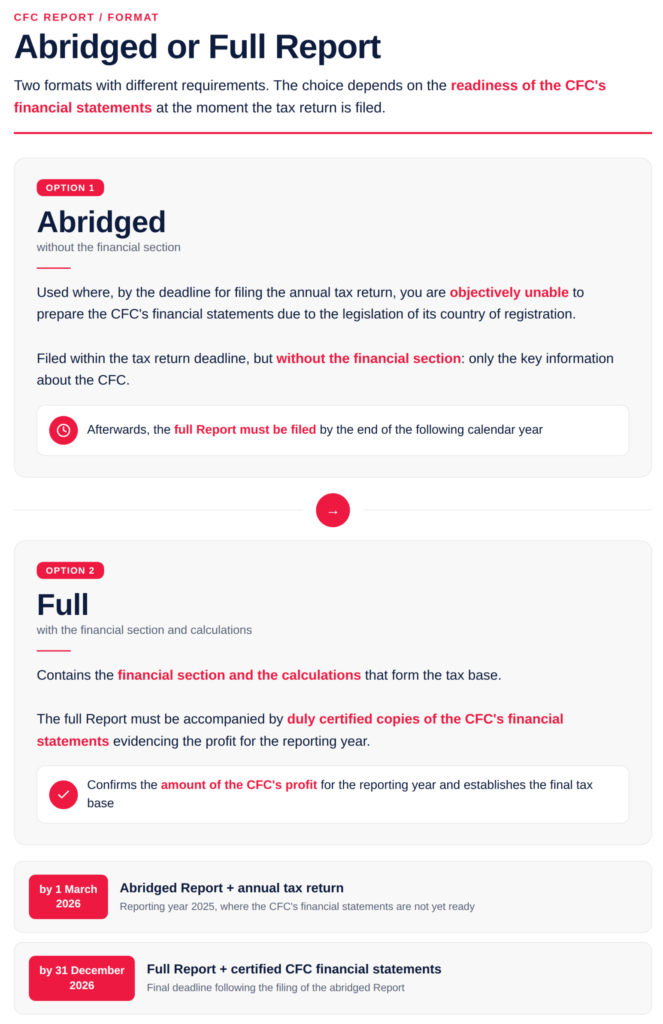
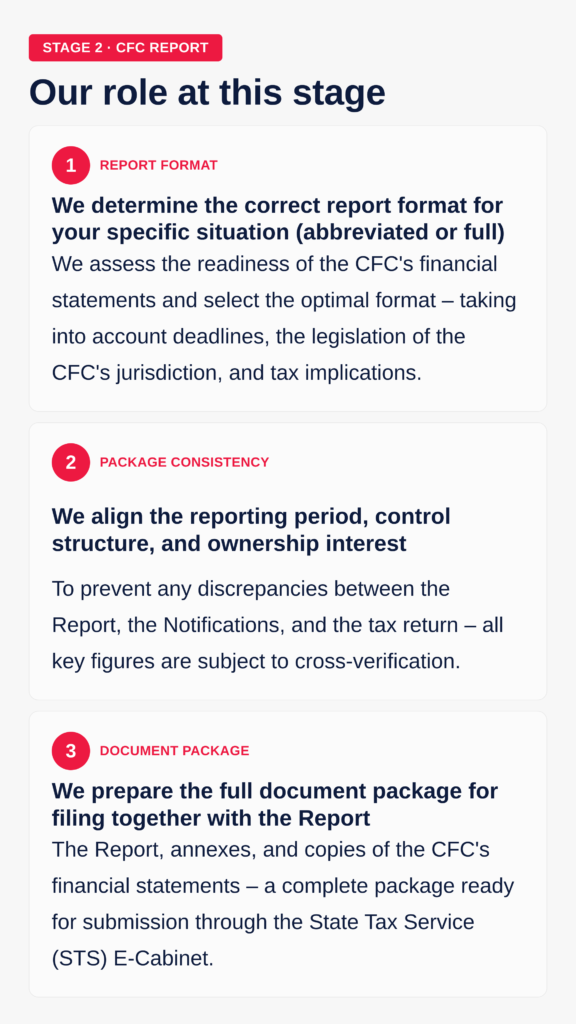
The abridged Report is used where, by the deadline for filing the annual tax return, the controlling person is objectively unable to prepare the financial statements of the controlled foreign company – in particular, due to the deadlines for their preparation under the legislation of the company’s country of registration. The full Report contains the financial section and the calculations that form the tax base, and is accompanied by duly certified copies of the financial statements of the controlled foreign company. If an abridged Report was filed for a given year, the full Report is to be submitted by the end of the calendar year following the reporting year. The choice of format at the outset has practical significance: it determines the logic of document preparation and the timing of obtaining financial statements from abroad.

Sanctions are established by paragraph 120.7 of Article 120 of the Tax Code of Ukraine and are calculated as a multiple of the subsistence minimum for an able-bodied person in force as of 1 January of the relevant tax (reporting) year. The list covers:

  • failure to submit the Notification on the acquisition or disposal of a participating interest, or on the commencement or termination of actual control – 300 subsistence minimums for each notification not submitted;
  • failure to submit the Report on the controlled foreign company – 100 subsistence minimums;
  • late submission of the Report – 1 subsistence minimum for each day of delay, but not more than 50 in aggregate;
  • failure to include mandatory information on controlled foreign companies in the Report – 3% of revenue or 25% of the controlled foreign company’s adjusted profit for the relevant year that is not disclosed in the CFC Report, but not exceeding 1,000 times the minimum subsistence level for each instance of failure to disclose a controlled foreign company and/or for all undisclosed amounts;
  • failure to provide transfer pricing documentation and copies of source documents upon request of the supervisory authority – 3% of income, but not more than 1,000 subsistence minimums.

The aggregate amount of sanctions is capable of exceeding the actual tax liability several times over, which makes compliance with deadlines and consistency of the submitted forms a priority in its own right.

The engagement is conducted under the regime of professional secrecy, with the application of internal procedures for access to information:

  1. a list of persons on the provider’s side with access to the materials of the specific engagement is defined;
  2. the transfer of documents is formalised contractually;
  3. where required, a separate non-disclosure agreement is concluded, taking into account the specific nature of the information on foreign companies, ownership structures, and beneficial owners.

The work begins with a preliminary assessment: a list is established of all foreign companies and entities without legal personality in respect of which the person is a controlling person or in respect of which grounds exist to presume the existence of control. For each controlled foreign company, the following are determined: the reporting period, the basis of control, the size of the participating interest, the availability of grounds for exemption from taxation, and the scope and timing of the financial statements available under the legislation of the relevant jurisdiction.

Where a request is received from the supervisory authority:

  1. explanations are prepared with reference to the legislative grounds, source documents, and financial statements of the controlled foreign company;
  2. the evidentiary basis supporting the information declared in the Report is assembled.

Main errors are identified in the submitted forms – the Notification, the Report, or the controlled foreign company annex to the tax return – corresponding amending documents are prepared, together with an assessment of the consequences of self-correction under the Tax Code. Consistency of the explanations with the previously submitted forms is fundamental: discrepancies in the position at different stages may themselves serve as a ground for further action by the supervisory authority.

Controlled Foreign Companies

Other services

Why Parker Russell UA?

Global Presence

in 75 countries

We don’t just consult — we implement structures in the relevant jurisdictions through local offices.

Comprehensive Approach

A combination of tax, legal, financial, and accounting expertise.

Screenshot 2025-06-16 at 13.55.45

High Level of Trust

Our services are used by large Ukrainian manufacturing, logistics, agricultural, and development companies.

Icon container

Compliance with International and Ukrainian Standards

Structures comply with BEPS rules, OECD standards, and the requirements of Ukrainian tax legislation.

Contact us

Leave a request — and we will help you build an effective, transparent, and long-term international structure tailored to your business, taking into account market specifics, Ukrainian legislation requirements, and global tax trends.

Написати нам

Залиште запит — і ми допоможемо побудувати ефективну, транспарентну та довгострокову міжнародну структуру саме для вашого бізнесу, з урахуванням особливостей ринку, вимог українського законодавства та глобальних податкових тенденцій.

Заповніть всі обов’язкові поля. Заявку надіслано.

Controlled Foreign Companies (CFCs)

Послуги

Міжнародне корпоративне структурування

У сучасних умовах війни в Україні, посиленого валютного контролю, обмеженого доступу до міжнародного фінансування та значного податкового навантаження, українські компанії все частіше виходять на зовнішні ринки, розміщують виробництво та постачання за межами України, укладають контракти з нерезидентами або переносять частину своєї діяльності за кордон. У таких обставинах правильно побудована міжнародна корпоративна структура — це стратегічний інструмент для збереження та зростання бізнесу.

Parker Russell UA — член міжнародної мережі Parker Russell International, що охоплює 75 юрисдикцій світу, — спеціалізується на розробці ефективних, законних та безпечних структур для міжнародного бізнесу, включаючи питання оподаткування, трансфертного ціноутворення, захисту прав інтелектуальної власності та дотримання правил щодо контрольованих іноземних компаній.

Навіщо компаніям потрібно міжнародне структурування?

  • Зниження загального податкового навантаження за рахунок використання міжнародних податкових угод, оптимізації джерел доходу та витрат, зокрема роялті та витрат на науково-дослідні роботи (R&D).
  • Побудова механізмів виплати дивідендів, роялті та міжгрупових платежів із дотриманням вимог українського та міжнародного законодавства.
  • Оптимізація структури витрат — створення центрів витрат або компетенцій у вигідних юрисдикціях для ефективного управління витратами на маркетинг, R&D, IP та інші нематеріальні активи.
  • Захист активів та прав інтелектуальної власності — розміщення прав на торговельні марки, патенти, програмне забезпечення в юрисдикціях з надійним захистом і вигідним податковим режимом.
  • Структурування міжнародної дистрибуції — створення контрактних моделей для імпорту/експорту товарів і послуг із прогнозованим рівнем податкового навантаження.
  • Підготовка до інвестицій або M&A — створення прозорої й привабливої для інвесторів холдингової моделі.

Наші послуги

Структурування міжнародних бізнес-груп

  • Створення оптимальної моделі корпоративної групи з урахуванням функцій, ризиків і ключових активів.
  • Побудова холдингових, сервісних, виробничих та торговельних компаній у Європі, Азії, на Близькому Сході або в США.
  • Визначення ролей компаній у групі: розробка моделей головної компанії, контрактного виробника, дистриб’ютора, R&D-центру.
  • Структурування роялті, ліцензійних платежів та витрат на дослідження й розробки (R&D) між компаніями групи.
  • Розміщення прав інтелектуальної власності в юрисдикціях із пільговим оподаткуванням доходів від використання IP.

Супровід у створенні та адмініструванні іноземних компаній

  • Реєстрація компаній у юрисдикціях, що відповідають потребам бізнесу.
  • Супровід відкриття банківських рахунків, підготовка статутних документів, перевірка бенефіціарів.
  • Консалтинг щодо вимог до реальної економічної присутності компанії (substance): офіс, персонал, звітність та дотримання вимог податкового резидентства.
  • Врахування положень щодо центру ефективного управління (Place of Effective Management, PoEM) при визначенні податкового статусу компаній.

Консалтинг з питань контрольованих іноземних компаній (КІК)

  • Аналіз наявності та статусу контрольованих іноземних компаній у групі українського бенефіціара.
  • Аналіз податкового навантаження, оцінка потенційних податкових ризиків та донарахувань в Україні за правилами КІК.
  • Супровід підготовки та подання звітності по КІК в Україні.
  • Консультації з питань достатності економічної присутності (substance) компаній у відповідних юрисдикціях.
  • Підготовка аналітичних висновків та обґрунтувань щодо окремих питань іноземних компаній КІК, в тому числі з питань оподаткування.

Трансфертне ціноутворення (ТЦУ)

  • Ідентифікація контрольованих операцій між резидентами України та пов’язаними нерезидентами.
  • Функціональний аналіз сторін операції, оцінка рівня ризиків і економічної цінності функцій.
  • Підготовка повного пакета документації з трансфертного ціноутворення (Local File, Master File, Country-by-Country Reporting).
  • Розрахунок ринкового рівня цін для товарів, послуг, роялті, фінансових операцій, витрат на R&D.
  • Розробка політики трансфертного ціноутворення для групи компаній.
  • Супровід у разі податкової перевірки або запитів від контролюючих органів.

Фінансовий та податковий супровід. Аудит. 

  • Підготовка фінансової звітності за МСФЗ для цілей декларування, консолідації, комплаєнсу або розкриття перед банками, інвесторами;
  • Підтримка під час податкового декларування: консультації та перевірка відповідності задекларованих показників щодо КІК, ТЦУ та нерезидентних операцій;
  • Аудиторські висновки для банків, інвесторів, контролюючих органів;
  • Незалежне підтвердження джерел походження коштів, платоспроможності, фінансового стану компаній та майнового стану бенефіціарів, а також відповідності фінансової звітності та податкових даних.

Для кого ці послуги?

  • Власники компаній, CEO — які шукають захист активів, оптимізацію корпоративних структур, вихід на міжнародні ринки.
  • Фінансові директори, головні бухгалтери — яким важлива законність, передбачуваність і ефективність податкових рішень.
  • Керівники відділів R&D, маркетингу та IT — які використовують інтелектуальну власність і потребують зрозумілої схеми оплати роялті або фінансування досліджень.
  • Юридичні служби — які відповідають за відповідність вимогам валютного контролю, КІК, ТЦУ та структурування договірних відносин із нерезидентами.

Чому Parker Russell UA?

  • Глобальна присутність у 75 країнах — ми не просто консультуємо, а реалізуємо структури у відповідних юрисдикціях через локальні офіси.
  • Комплексний підхід — поєднання податкової, юридичної, фінансової й бухгалтерської експертизи.
  • Високий рівень довіри — наші послуги використовують великі українські виробничі, логістичні, аграрні та девелоперські компанії.
  • Відповідність міжнародним та українським нормам — структури відповідають правилам BEPS, стандартам OECD та вимогам податкового законодавства України.

Залиште запит — і ми допоможемо побудувати ефективну, транспарентну та довгострокову міжнародну структуру саме для вашого бізнесу, з урахуванням особливостей ринку, вимог українського законодавства та глобальних податкових тенденцій.

Get in touch

For any questions about our services, please get in touch with one of our expert advisors.

Our locations

Global Map

View the locations and contact information for over 75 international offices.

Newsletter

Stay informed about all our latest updates and services, and sign up to our email newsletter.

Cookies are used on our site to help give you the best user experience possible and to provide a level of enhanced functionality. If you continue viewing the site without changing your settings, we will assume you are happy to receive all cookies. Your cookie settings can be changed at any time by using the guidelines in our cookie policy. You can also click on the information button for further details.