Starting from the 2025 reporting year, the Report on Controlled Transactions must be submitted using the updated form, taking into account the amendments introduced by Order No. 312 of the Ministry of Finance of Ukraine dated 12 June 2026. The updated form contains new fields and clarified requirements.
In particular, the Annex to the Report has been supplemented with new related-party relationship codes — 525 and 526 — which affect the determination of the scope of transactions and the volume of information subject to disclosure.
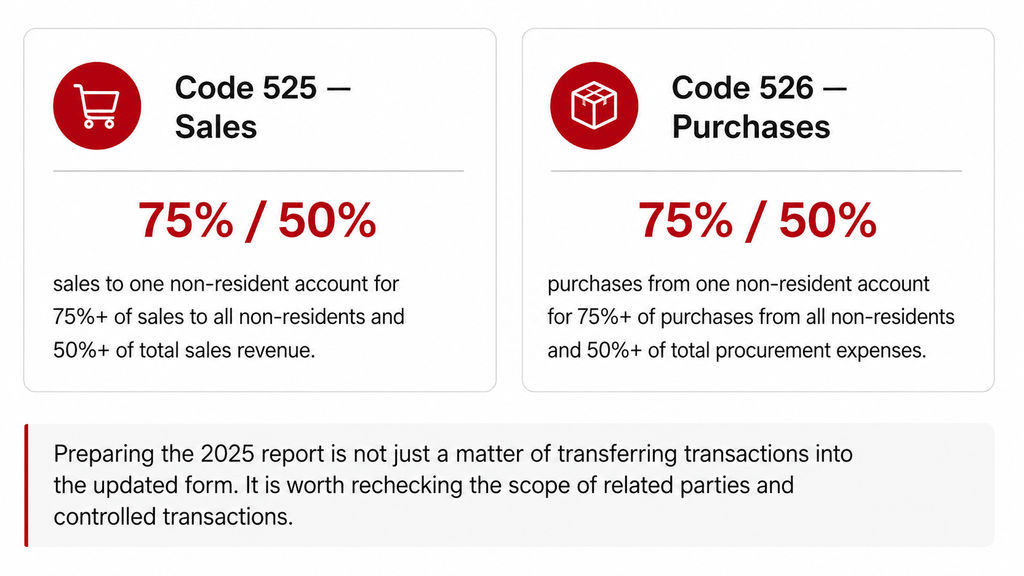
The new codes are used to report cases of economic dependence of a resident on a particular non-resident resulting from a significant concentration of transactions involving the sale or purchase of goods, works or services. Therefore, starting from the 2025 reporting year, for transfer pricing purposes, companies must analyse not only ownership structures, corporate control and common beneficial owners, but also the actual economic concentration of transactions with individual non-residents.
To minimise potential risks and questions from the tax authorities, it is important to review in advance the underlying data, the scope of controlled transactions and the consistency of the information disclosed in the Report with the company’s actual data. Particular attention should be paid to the correct determination of related-party criteria in respect of non-residents and the accurate disclosure of the relevant information in the Annex to the Report.
What if the Report for 2025 has already been submitted?
The State Tax Service of Ukraine has separately clarified that Reports on Controlled Transactions for 2025 submitted before the updated form entered into force remain valid. Therefore, the mere approval of the new form does not automatically require a Report that has already been submitted to be re-filed.
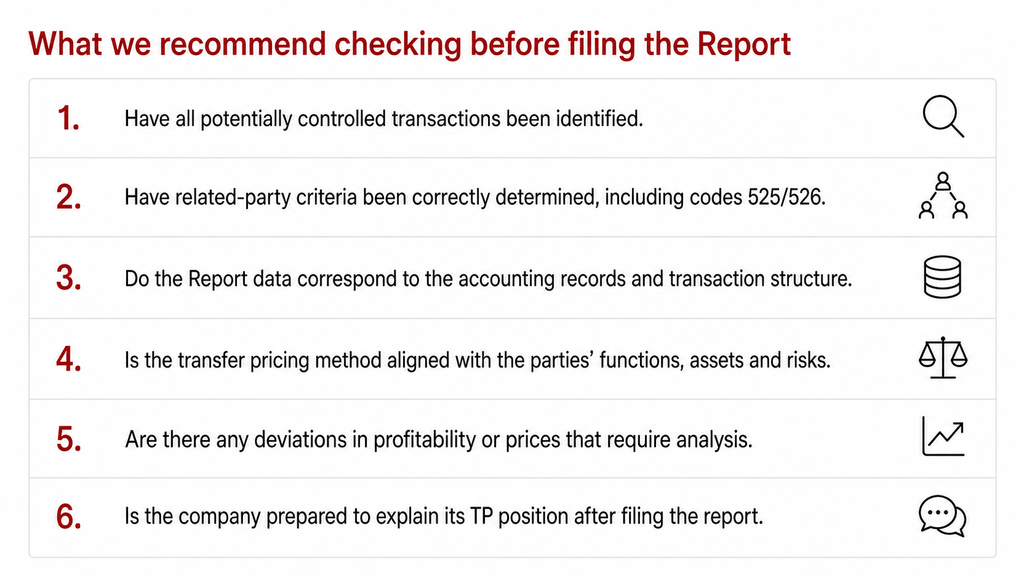
Parker Russell TP Pre-Filing Review

review of the scope of controlled transactions;
analysis of related-party criteria, including codes 525/526; review of the consistency and completeness of the Report;
reconciliation of the Report with financial and operational data;
identification of material transfer pricing risks.