Transfer Pricing Services

Transfer Pricing

Comprehensive business support – from reporting preparation to defence of interests during tax audits. 

Transfer pricing support becomes relevant at a specific stage of business development: when the operating structure grows more complex, related-party counterparties emerge, and the volume of transactions moves the company beyond the boundaries of standard compliance. At that point, documentation ceases to be merely a reporting requirement and becomes an evidentiary foundation — one that shapes the taxpayer’s position in dealings with the tax authorities, external advisers, or counterparties to a transaction.

01 Large Businesses with Cross-Border Operations

Companies that regularly engage in transactions with foreign counterparties — including the import of raw materials, supplies, or components; the export of finished goods; and the procurement of services, licences, or software — fall within transfer pricing control once the counterparty is either a related party or included in the lists approved by the Cabinet of Ministers of Ukraine, regardless of whether the group is international in a formal corporate sense.

The core risk area is typically shaped by two scenarios.

The first is the sale of products through a non-resident intermediary at prices below market level. In such cases, the tax authorities assess whether the pricing complies with the arm’s length principle and whether there is sufficient justification for deviations from the market range.

The second is imports from related-party suppliers or suppliers registered in low-tax jurisdictions. Here, the key risk arises from the absence of a functional and risk analysis capable of explaining how margin is allocated between the parties.


02 Ukrainian Members of International Groups

In such structures, the Master File is prepared by the parent company, while the Local File remains the responsibility of the Ukrainian entity. What matters is not the mere existence of documentation, but its consistency across levels and its alignment with the group’s positions in other jurisdictions. For the Ukrainian company, the key issue is therefore not only whether a local file formally exists, but whether it is compatible with the broader logic of the group’s transfer pricing documentation. Through automatic exchange of information mechanisms, the tax authorities are able to compare group reporting across several countries simultaneously.

Differences in the characterization of the same entity’s functions or risks across jurisdictions become an independent basis for information requests and tax adjustments, regardless of how accurately the price has been determined at the level of a particular transaction. In this model, risk arises not only at the level of the individual transaction, but also at the level of the consistency of the group’s overall position.


03 Companies with Transactions of a Special Nature

Royalties and licence fees, intra-group management or support services, loans and guarantees, and transfers of intangible assets are all categories in which the tax authorities assess not only whether the price is at arm’s length, but also whether the Ukrainian party has received a genuine economic benefit and whether the payment may in fact constitute a disguised distribution of profit.

The risk here does not primarily lie in the price itself. It lies in the taxpayer’s ability to substantiate the economic rationale of the transaction for the Ukrainian entity, irrespective of its intra-group nature. If such a position has not been prepared before the start of a tax audit, it will have to be constructed under strict procedural deadlines and with materially reduced scope for an effective defence.


04 Businesses at the Stage of a Corporate Transaction

An investment round, sale of a business, debt financing, or restructuring — in each of these scenarios, transfer pricing documentation is reviewed by external advisers against standards that are often more demanding than those applied in a tax audit. Documentation prepared on a purely formal basis, or in the logic of a single reporting year without regard to the structure of the group as a whole, will typically not withstand that review — and at this stage, there is usually no longer any real opportunity to bring it into line.

This is the key distinction from ordinary tax risk: in the context of a transaction, weak documentation affects the valuation of the asset, the financing terms, or even the feasibility of closing the deal itself.

01 Large Businesses with Cross-Border Operations

Companies that regularly engage in transactions with foreign counterparties — including the import of raw materials, supplies, or components; the export of finished goods; and the procurement of services, licences, or software — fall within transfer pricing control once the counterparty is either a related party or included in the lists approved by the Cabinet of Ministers of Ukraine, regardless of whether the group is international in a formal corporate sense.


The core risk area is typically shaped by two scenarios.


The first is the sale of products through a non-resident intermediary at prices below market level. In such cases, the tax authorities assess whether the pricing complies with the arm’s length principle and whether there is sufficient justification for deviations from the market range.


The second is imports from related-party suppliers or suppliers registered in low-tax jurisdictions. Here, the key risk arises from the absence of a functional and risk analysis capable of explaining how margin is allocated between the parties.

02 Ukrainian Members of International Groups

In such structures, the Master File is prepared by the parent company, while the Local File remains the responsibility of the Ukrainian entity. What matters is not the mere existence of documentation, but its consistency across levels and its alignment with the group’s positions in other jurisdictions. For the Ukrainian company, the key issue is therefore not only whether a local file formally exists, but whether it is compatible with the broader logic of the group’s transfer pricing documentation. Through automatic exchange of information mechanisms, the tax authorities are able to compare group reporting across several countries simultaneously.


Differences in the characterization of the same entity’s functions or risks across jurisdictions become an independent basis for information requests and tax adjustments, regardless of how accurately the price has been determined at the level of a particular transaction. In this model, risk arises not only at the level of the individual transaction, but also at the level of the consistency of the group’s overall position.

03 Companies with Transactions of a Special Nature

Royalties and licence fees, intra-group management or support services, loans and guarantees, and transfers of intangible assets are all categories in which the tax authorities assess not only whether the price is at arm’s length, but also whether the Ukrainian party has received a genuine economic benefit and whether the payment may in fact constitute a disguised distribution of profit.


The risk here does not primarily lie in the price itself. It lies in the taxpayer’s ability to substantiate the economic rationale of the transaction for the Ukrainian entity, irrespective of its intra-group nature. If such a position has not been prepared before the start of a tax audit, it will have to be constructed under strict procedural deadlines and with materially reduced scope for an effective defence.

04 Businesses at the Stage of a Corporate Transaction

An investment round, sale of a business, debt financing, or restructuring — in each of these scenarios, transfer pricing documentation is reviewed by external advisers against standards that are often more demanding than those applied in a tax audit. Documentation prepared on a purely formal basis, or in the logic of a single reporting year without regard to the structure of the group as a whole, will typically not withstand that review — and at this stage, there is usually no longer any real opportunity to bring it into line.


This is the key distinction from ordinary tax risk: in the context of a transaction, weak documentation affects the valuation of the asset, the financing terms, or even the feasibility of closing the deal itself.
Conditions Under Which Transactions Fall Within Transfer Pricing Rules

Determining whether a transaction is controlled is not a technical formality, but the starting point for the entire transfer pricing analysis.

An error at this stage is carried through every subsequent step: reporting, documentation, and the taxpayer’s position during a tax audit.


For this reason, it is essential to understand the conditions under which a transaction falls within transfer pricing control, including how

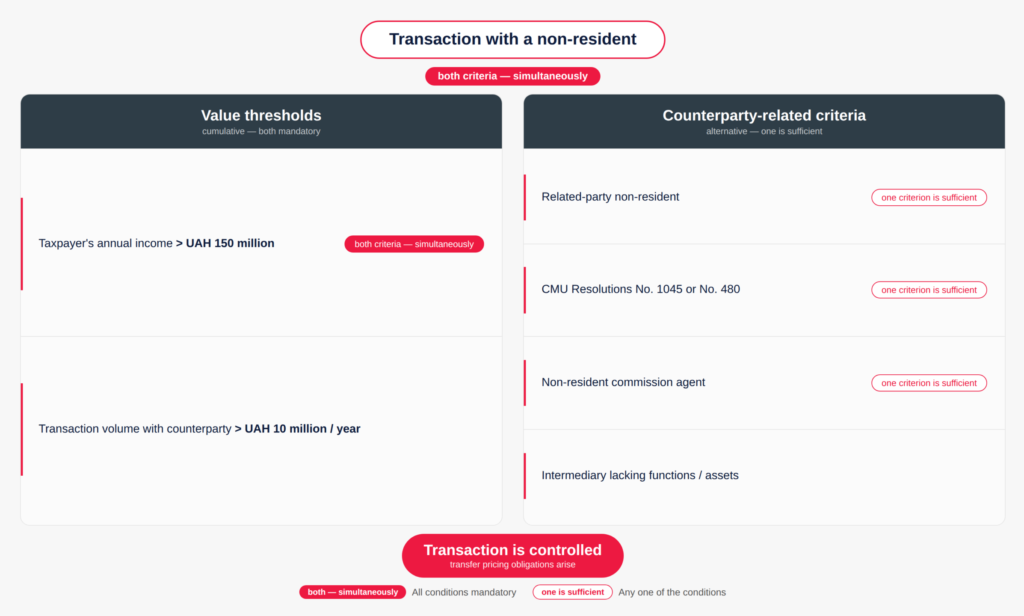
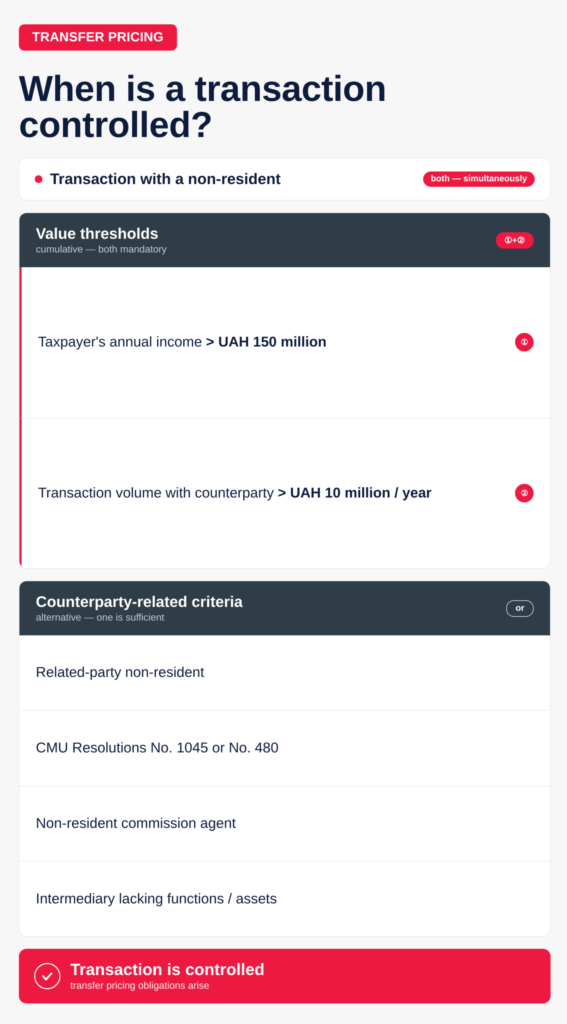
A transaction falls within transfer pricing control if the value thresholds are met and at least one counterparty-related criterion also applies

Value thresholds:

  1. The taxpayer’s annual income exceeds UAH 150 million.
  2. The volume of transactions with each counterparty exceeds UAH 10 million per year.


Counterparty-related criterion:


1. Transactions with a non-resident registered in a state (or territory) included in the list approved by Resolution of the Cabinet of Ministers of Ukraine No. 1045.

This list includes states or territories that display offshore characteristics, do not comply with international standards in the area of anti-money laundering and counter-terrorist financing, or do not ensure an adequate exchange of tax and financial information with Ukraine. Proposals for inclusion in the list are submitted annually by the State Tax Service by 1 October, and any amendments apply from 1 January of the following year or, depending on the date of approval, from the next reporting year thereafter.


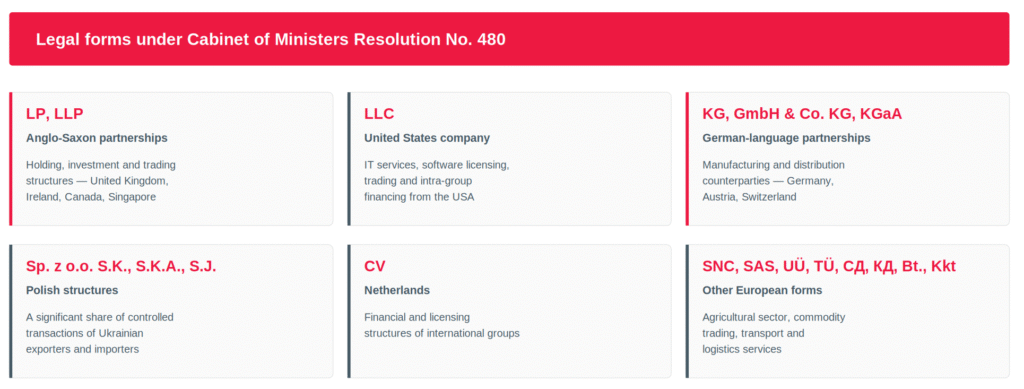
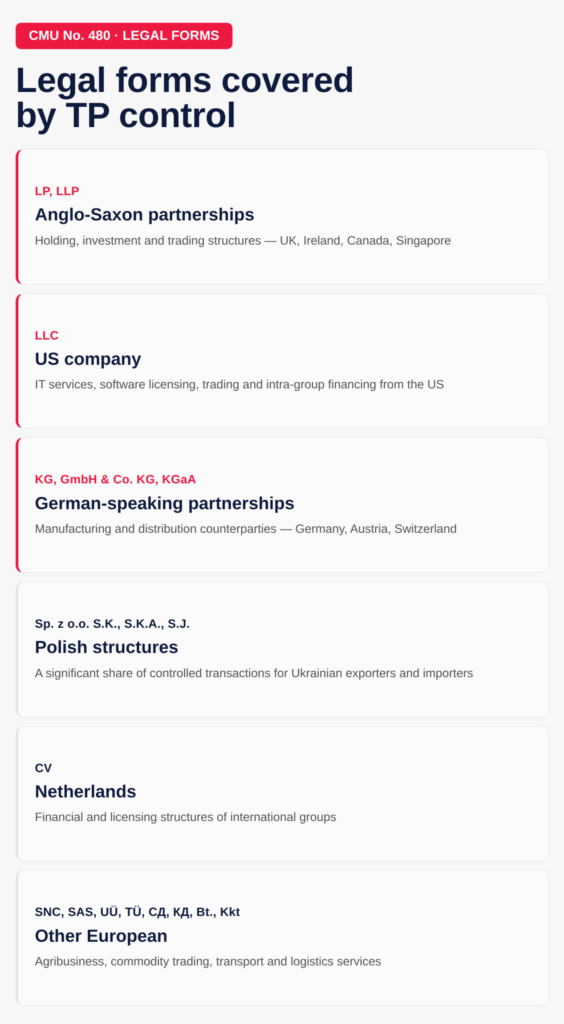
2. Transactions with a non-resident whose legal form is included in the list approved by Resolution of the Cabinet of Ministers of Ukraine No. 480

A proper understanding of this list makes it possible to assess quickly whether a particular counterparty falls within transfer pricing control under the counterparty-related criterion of the list approved by Cabinet of Ministers Resolution No. 480, even before conducting a detailed analysis of its tax status.

3. Transactions through a non-resident commission agent


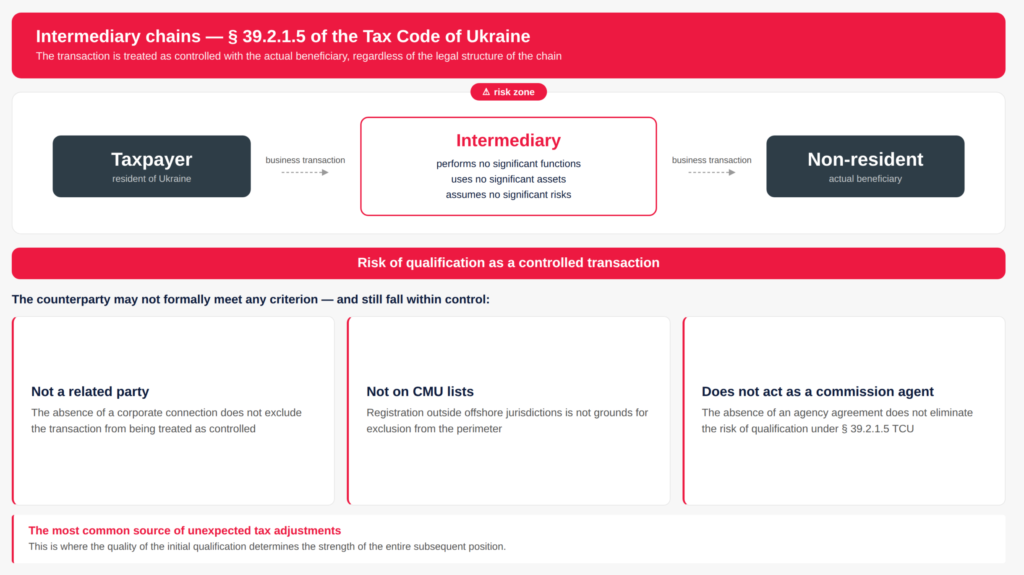
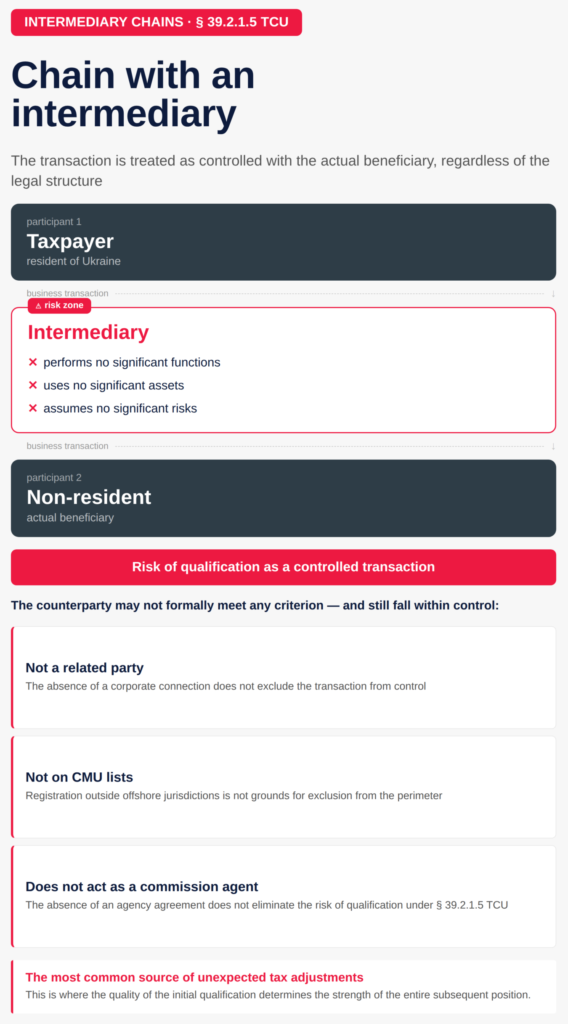
Intermediary chains under subparagraph 39.2.1.5 of the Tax Code of Ukraine are the most technically complex part of defining the transfer pricing perimeter — and the area in which both self-assessment errors and disputes with the tax authorities arise most frequently.


Subparagraph 39.2.1.5 of the Tax Code extends transfer pricing control to transactions that, on their face, do not meet any of the basic counterparty-related criteria:
the counterparty is not a related party,
is not included in the Cabinet of Ministers’ lists,
and does not act as a commission agent.


However, if an intermediary is inserted between the Ukrainian taxpayer and the ultimate non-resident in the chain, and that intermediary performs no real functions, uses no assets of its own, and assumes no risks typical for the relevant business practice, the transaction is treated as controlled with the actual beneficiary, regardless of the legal structure of the chain.


In practice, this means that the formal absence of related-party status or offshore status of the counterparty is not, in itself, sufficient to exclude the transaction from the transfer pricing perimeter. This is precisely where unexpected tax adjustments most often arise — and where the quality of the initial qualification determines the strength of the entire position going forward.


Transactions through non-resident intermediaries that do not perform significant functions, do not use significant assets, and do not assume significant risks.

4. Separate Rule

Transactions between a non-resident and its permanent establishment in Ukraine are treated as controlled solely by virtue of their occurrence, without applying the value thresholds of UAH 150 million in annual income and UAH 10 million in transaction volume. In practice, this means that any payment between the non-resident’s head office and its Ukrainian permanent establishment gives rise to a transfer pricing reporting obligation.

Our services

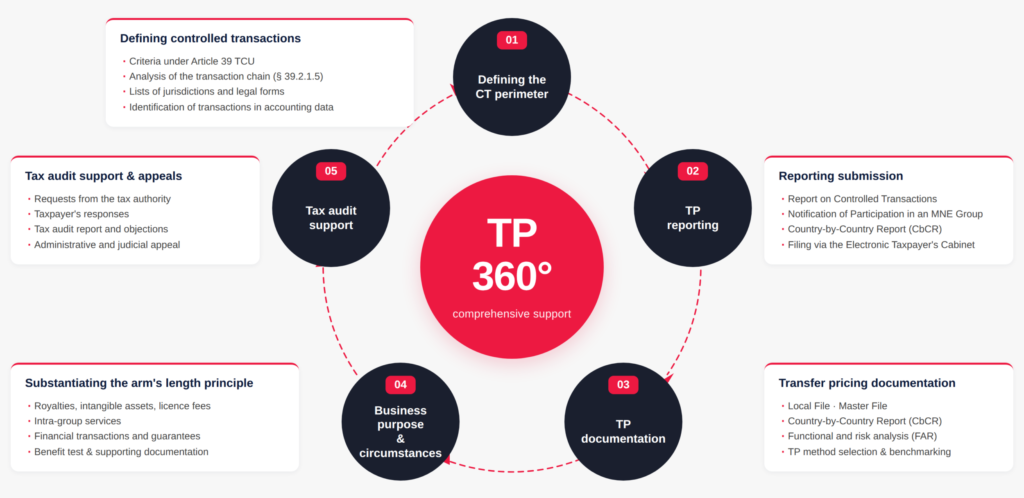
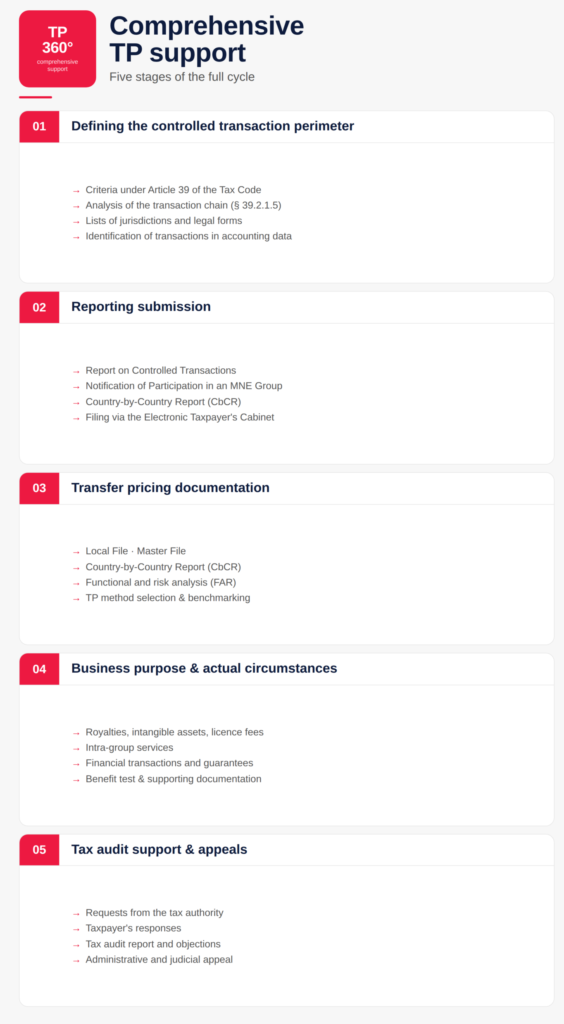
Defining the Controlled Transaction Perimeter


The analysis covers transactions with non-residents against the criteria set out in Article 39 of the Tax Code of Ukraine, including the economic connectedness criteria (75% of turnover with one counterparty, provided that such transactions account for 50% of the total volume of transactions with non-residents), the qualification of intermediary chains, and transactions exposed to a risk of recharacterisation by the tax authorities.


Particular attention is given to transactions with a methodologically debatable perimeter: agency and commissionaire structures, intra-group services with an unclear functional profile, financing through non-resident structures, and transactions involving intangible assets where no formal licence arrangement is in place.


For clients using 1C, BAS, or SAP, we integrate the identification of controlled transactions directly into the accounting system. This removes dependence on manual data selection and ensures the perimeter remains consistent and reproducible from one reporting cycle to the next.

Three-Tier Documentation


The Local File forms the core element of the documentation package. We prepare it with a functional and risk analysis, method selection rationale, and benchmarking based on international databases such as Amadeus, Orbis, or RoyaltyRange, depending on the nature of the transaction and the jurisdictional profile of the counterparty.


The Master File is prepared where its preparation is the responsibility of the Ukrainian taxpayer. Its content is aligned with the CbCR and reflects the group’s actual structure — including the functional profile of the participants, the allocation of risks, and the location of intangible assets across the group as a whole.


The Country-by-Country Report is prepared for groups that meet the consolidated revenue threshold, as the third level of the package, with internal consistency maintained across all three levels of documentation.

The depth of analysis at each level is determined by the risk profile of the transaction. Royalties, intra-group financing, and transfers of intangible assets require a different level of substantiation than standard goods transactions.

Economic Substantiation of Business Purpose


The State Tax Service is consistently expanding the range of transactions in which the issue is no longer the price, but the economic rationale of the arrangement itself. The absence of a quantifiably substantiated benefit for the Ukrainian taxpayer may therefore serve as an independent basis for tax adjustments, regardless of whether the transfer price itself has been determined correctly.


The highest level of risk is concentrated in transactions where economic substance is the most difficult to formalise: royalties and licensing, intra-group services, financing through non-resident structures, guarantees, and transfers of intangible assets.


For these categories, we prepare both quantitative and qualitative substantiation of economic benefit within the meaning of Article 39 of the Tax Code of Ukraine, with a position that covers the conclusion of the transaction, its actual performance, and its accounting treatment.

Transfer Pricing Reporting


We provide full-cycle preparation and filing through the Electronic Taxpayer’s Cabinet, including the Report on Controlled Transactions, the Notification of Participation in an International Group of Companies, and the Country-by-Country Report, with methodological consistency across all forms and alignment with the defined transfer pricing perimeter.


For groups in which reporting obligations are allocated across multiple jurisdictions, we coordinate disclosures at group level before filing. Inconsistencies between positions taken in different jurisdictions become visible through automatic exchange of information mechanisms and are among the most common triggers for inquiries from the State Tax Service.

Support in Responding to STS Requests and During Tax Audits


Our support begins with an analysis of the request itself: qualification of the grounds, assessment of the risk of tax adjustments, and selection of the response strategy. The response is then structured as a consistent position aligned with the Local File, Master File, and the filed reporting forms, since any discrepancy between the documented position and the position set out in the response is one of the common triggers for escalation of a tax audit.


In the event of a documentary tax audit, we provide full support from the initial request for documents through to objections against the audit report. Where tax adjustments are imposed, we prepare the position for administrative appeal and support the court proceedings.


All stages are handled by the same team, ensuring that the methodology remains consistent at every level.

FAQ

How can a company determine whether its transactions fall within transfer pricing control?

Transfer pricing control arises where two value thresholds are met simultaneously — the company’s annual income exceeds UAH 150 million and the volume of transactions with a particular non-resident counterparty exceeds UAH 10 million — and at least one counterparty-related criterion is present.


The counterparty-related criteria include: related-party status of the counterparty, its registration in a jurisdiction included in the list approved by Cabinet of Ministers Resolution No. 1045, its legal form being included in the list approved by Cabinet of Ministers Resolution No. 480, its status as a non-resident commission agent, the involvement of an intermediary lacking real functions and assets, or the existence of a permanent establishment.


It is important to distinguish between the two sets of criteria. The value thresholds are cumulative, meaning both must be exceeded at the same time. The counterparty-related criteria, by contrast, are alternative: the presence of just one is sufficient.

Related-party status is determined under one of the four criteria set out in subparagraph 14.1.159 of the Tax Code of Ukraine: direct or indirect ownership of 25% or more of corporate rights (the threshold was increased from 20% effective 1 January 2025), management control, economic connectedness through turnover concentration (75% with one counterparty or 50% with a related group of counterparties), or connection through individuals acting as ultimate beneficial owners.

The fact that a counterparty is registered in an EU country does not, in itself, remove a transaction from transfer pricing control. If the counterparty is a related party, has a legal form included in the list approved by Cabinet of Ministers Resolution No. 480 — for example, Polish Sp. z o.o. S.K. or S.K.A., German KG or GmbH & Co. KG, or Italian SNC or SAS — or acts as a commission agent, the transaction is treated as controlled regardless of the jurisdiction of registration.

If there is an intermediary between the Ukrainian taxpayer and the ultimate non-resident counterparty, and that intermediary performs no real functions, uses no assets of its own, and assumes no risks typical for the relevant business practice, the State Tax Service is entitled to disregard the intermediate links and treat the transaction as having been carried out directly with the ultimate counterparty.

If, following a tax audit, the State Tax Service concludes that the transaction price exceeded the arm’s length level to the benefit of the non-resident, the amount of the adjustment is treated as constructive dividends. The result is a двойna tax exposure: an additional corporate income tax charge on the adjustment amount, plus withholding tax on repatriation.

The standard rate is 15%, but it may be reduced under an applicable double tax treaty with the country of residence of the ultimate beneficial owner — typically to 5% or 10%, depending on the size of the non-resident’s participation in the capital of the Ukrainian taxpayer.

Yes. In such cases, the documentation standard is usually higher than for a profitable transaction. The obligation to prepare transfer pricing documentation does not depend on the financial result, and a pattern of losses in controlled transactions is one of the key triggers for a scheduled tax audit. In these circumstances, the economic substantiation must do more than merely record the fact of the loss — it must convincingly explain why an independent party, acting under market conditions, would have agreed to comparable transaction terms.

The Report on Controlled Transactions and the Notification of Participation in an International Group of Companies must be filed by 1 October of the year following the reporting year. The Country-by-Country Report must be filed within 12 months after the end of the group’s financial year. Transfer pricing documentation must be provided in response to a request from the State Tax Service within 30 days of receipt, while objections to a tax audit report must be submitted within 10 business days.

The applicable limitation period is 2,555 days, that is, seven years, which is significantly longer than the standard 1,095-day period generally applicable in other tax matters.

The burden of proof rests with the taxpayer. If the State Tax Service determines that an intermediary in the chain performs no real functions, uses no assets of its own, and assumes no risks, it may recharacterise the transaction as having been carried out directly with the ultimate non-resident counterparty, with the corresponding adjustment and its treatment as constructive dividends. The taxpayer must therefore be able to demonstrate that each link in the chain has an independent business rationale and performs functions without which the transaction, in its existing form, could not objectively have taken place. In practice, if that substantiation is absent from the documentation at the time of the audit, the tax authority’s position is often difficult to displace.

The sanctions under Article 120 of the Tax Code of Ukraine are linked to the subsistence minimum for an able-bodied person as at 1 January of the reporting year in which the violation occurred. For 2026, that amount is UAH 3,328. The penalties operate on two levels.


The first level is procedural. Failure to submit the Report on Controlled Transactions, the Master File, or the Country-by-Country Report triggers a penalty of 300 subsistence minima for each violation, which in 2026 amounts to UAH 998,400. Failure to submit the Notification of Participation in an International Group of Companies triggers a penalty of 100 subsistence minima, or UAH 332,800 in 2026. For late filing, the penalty is 1 subsistence minimum for each calendar day of delay, subject to statutory caps: not more than 300 subsistence minima for the Controlled Transactions Report, not more than 200 for the Local File, not more than 300 for the Master File and the CbCR, and not more than 50 for the group participation notification.


The second level is substantive. Failure to include controlled transactions in the filed Report results in a penalty of 1% of the value of the undeclared transactions, capped at 300 subsistence minima. Failure to provide transfer pricing documentation upon request from the State Tax Service results in a penalty of 3% of the value of the relevant transactions, capped at 200 subsistence minima. For members of international groups that fail to disclose transaction information in the Master File, the penalty is 1% of the value of the transactions across the group, capped at 300 subsistence minima. Payment of the penalty does not release the taxpayer from the obligation to file the relevant reporting.

Transfer pricing

Our experts in transfer pricing

Other services

Why Parker Russell UA ?

Global Presence
in 75 Countries
We work closely with our international partners to implement local solutions that comply with national and global regulations.

Full Lifecycle Coverage

From planning and documentation to audit defense and APA negotiation

Multidisciplinary Expertise

Economists, auditors, tax lawyers, and compliance consultants under one roof

Confidential, Strategic, and Sustainable

Everything we deliver is structured to stand up in audits, boardrooms, and public markets

Contact us today

To develop a well-documented, compliant, and future-ready international structure tailored to your business strategy.

Contact us today

To develop a well-documented, compliant, and future-ready international structure tailored to your business strategy.

Fill in all required fields. The application has been sent.

Cookies are used on our site to help give you the best user experience possible and to provide a level of enhanced functionality. If you continue viewing the site without changing your settings, we will assume you are happy to receive all cookies. Your cookie settings can be changed at any time by using the guidelines in our cookie policy. You can also click on the information button for further details.